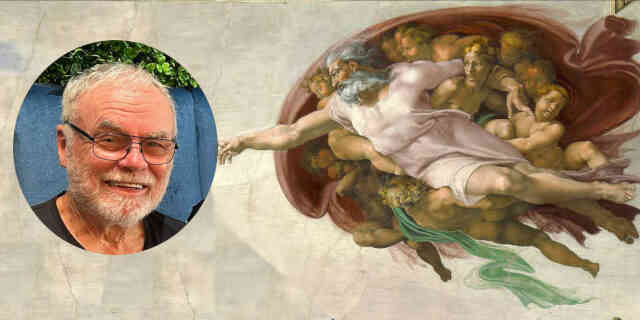
I turned 80 last year, meaning I’ve been a Christian theist for more than 60 years. But my belief hasn’t been at all constant.
During all that time I seem have been continually reviewing what I believe, jettisoning some beliefs, strengthening others. I read a lot, continually upgrading my understanding of philosophy, science, history, theology and human nature, and thus challenging my beliefs.
So where have I ended up? What has stood the test of time and new information? And what has bitten the dust? Here’s a quick summary.
Logical vs psychological beliefs
People believe and disbelieve for all sorts of reasons. We might like to think we’re sensible and reasonable, but our preferences, wishes and settled opinions can surely influence us all.
I’m sure I’m not immune from all that. But I’ve tried to not allow it to govern my conclusions. Being more analytical than intuitive in my thinking certainly helps (in that way, not always in others!) So what follows is the way my brain thinks, hopefully not too much of what my feelings want!
You might find a few surprises in my conclusions.
Reasons to (dis)believe
No God = no universe
I can’t get away from this truth. If there was no God (defined in the broadest sense) there’d be no universe – no space, matter or energy.
I know philosophers have debated this for millennia, but if there was once nothing at all, then there’s no way that something would come into existence for no reason and with no cause. So there has to be something that is eternal, that always was/is.
And this thing has to be outside time. It seems impossible to me for the universe to have always existed. Infinite past time doesn’t seem possible to me. And if the universe had existed for infinite time, everything that could have happened would have happened an infinite time ago, and we’d be left with a static homogeneous universe. Nothing could happen and no life could exist.
So I can only conclude that something immaterial and outside of time as we know it caused the universe. Call it God, or a god, or a life force, whatever, it’s the only explanation that make sense to me.
This conclusion is reinforced for me by the scientific fact that the diverse, life-supporting universe we know requires very precise laws to work, a precision that is statistically unlikely beyond imagining if it all happened by chance. Something designed it to work this way.
We can’t live without our humanity
I am a humanist in that I believe human life has amazing features and deep value. People matter. Choices matter. Right and wrong are important. We carry some moral responsibility for our actions.
But a purely materialistic worldview doesn’t explain this. It says that logically we don’t have truly free choice – the physical processes in our brains control our choices.
Without free will, we can’t be morally respopnsible for our actions, any more than a rock has responsibility for rolling down a hill and smashing into us. And there can’t be any truly objective morality because our moral sense has evolved for survival. Whatever helps us or our tribe survive is “good”.
And it is difficult to see how we could even argue about these matters if materialism was true, because your brain and mine wouldn’t be controlled by reason and logic in the end, but by physical processes which also evolved for survival more than truth.
I believe human experience shows us all this is untrue. Genocide and pedophilia really are evil and wrong. We do have some genuine choice, even if only partial. Our arguments and discussions really have value. The science which says otherwise is predicated on materialistic assumptions and is therefore unable to fully “see” the issues.
So I think pure materialism cannot be true. Our common human experience shows this. Again, there must be something more. And that something seems to have purpose and ethics.
The pain of the world
But it is equally true that the world isn’t always a very nice place. Beautiful in one way, horrific in others.
There is so much pain, and with our mobile phones, we have the pain of the world in our back pockets, and can’t avoid it.
A lot of it can be explained bu poor human choices, and by our willingness to flirt with danger in a physical world.
But the evolution of life is built on predation, competition and self interest. So pain is fundamental in our world. So if there’s a God, he or she doesn’t appear to be as “good” as we’d like to think.
Of course “good” isn’t something that has any real meaning if materialism is true, so the pain of the world can’t totally work against the existence of God. But it does make belief in a good God more difficult.
“There’s something to be learned in every human experience”
(Lou Reed)
Some people argue that God is so hidden from us that he can’t be there. But others say they’ve experienced God in some way – through divine healing, a vision, a voice, a deep experience or divine guidance.
I have investigated the apparent experiences of God and believe many of them are mistaken, but there are enough that seem well evidenced to make it difficult to dismiss them. But the fact that so many people never have such experiences makes me wonder why.
Does God really care?
With all that evidence, it seems God’s there (somewhere), but you’d have to wonder if he really cares. How could we know?
Through the ages there’ve been many gurus claiming to speak for God. Maybe many of them do in some ways or other. But Jesus still seems to me to speak about God with a stronger and more trustworthy voice.
The historical evidence for his life and teachings is good, even for those who don’t buy into his divinity or his miracles. His teaching and actions (where I can understand them) seem admirable, believable and convincing.
And the God Jesus taught us about seems to match the God I find in the universe and humanity.
So I find it makes more sense to believe in him than not. When he says that God cares for us, I believe him. When he calls us to follow him I still feel it is right to respond.
But the way I respond has changed a bit over the years.
Evolving beliefs
Understanding the Bible
For many Christians, the Bible is a book more or less written by God to reliably tell us a whole lot of truths we need to know. But how do we know that is true? What is the evidence?
Looking closer, there’s a lot of reasons to doubt this belief. There seem to be many errors (or at least inconsistencies) – you can find websites that list hundreds of them. We can explain many of them, but some remain beyond explanation. In addition some behaviour attributed to God seems despotic and murderous.
Yet at the same time, there are sublime teachings and deep understandings. The Sermon on the Mount (Matthew 5-7) is a high point in unselfish ethics.
How can we reconcile these differences?
A key to me was discovering that Jesus and his apostles didn’t have the same view about the supposed unchangeable truths of their scriptures (the Bible’s Old Testament). Time and time again, the New Testament records them changing the meaning of Old Testament passages and updating its teachings. Even while respecting their scriptures as holy.
And Old Testament experts tell us that the culture of the day led to exaggerated numbers and over-stated battle victories. Story tellers were more interested in their message and what they believed God was doing than in recording what we could capture on a video.
So I believe we should take account of all this. The Bible is important, inspired by God – though what exactly does “inspired” mean? Not everything in it is literally, factually true; some of it is folk tale, poetry, exaggerated history, etc. The scientific evidence clearly points to evolution being true and there being no worldwide flood. The historical and archaeological evidence points to some of the conquest stories being “fictionalised history”. Some things attributed to God depict part of the learning journey they were on, and don’t fairly represent God.
But when we come to the New Testament we are dealing with history, still with interpretation and faith, but recorded as accurately as the standards of the day allowed. So we can be confident that the gospels give us a good picture of Jesus’ life and teaching. And that’s enough for me to build my beliefs on.
Understanding Jesus
When I went to a church youth group as a teenager, it was pretty clear what I needed to know about Jesus. He was the Son of God, he died to save me from my sins and he was resurrected to put the seal on his claims. All the rest about him was secondary.
Trouble was, as I read the gospels (as a good christian boy should!) I found a very different Jesus. A much more interesting Jesus. A somewhat mysterious Jesus.
After some reading of how historians saw Jesus, I began to understand better. He was a first century Jew. His message was the dawning reign of God (he called this the “kingdom of God”). He didn’t just come to die, he came to give us a better picture of God, to rock the boat, to strengthen our ethics, to start a revolution to change the world – beginning with me.
Some historians (e.g. Bart Ehrman) see Jesus as an apocalyptic prophet, announcing God’s kingdom and the promise of freedom and vindication for the Jews, when the oppressive Romans would be put in their place. Which of course didn’t happen in the way the Jews wanted. So apparently a failed prophet.
But there is plenty in the gospels to show that while Jesus was indeed an apocalyptic prophet, he was much more. He was establishing a quite different kingdom than the forceful one some Jews hoped for. It was a different kind of revolution – “The kingdom of God is within you” and couldn’t be observed (Luke 17:20-21). And this kingdom didn’t fail because Jesus now has billions of followers.
I gave up following the western Protestant version of Jesus a long time ago, and now try to follow the Jewish Jesus who did indeed die for my sins and rise again, but did this in the larger context of the kingdom of God. This has implications …..
Heaven & hell
My early faith was simple. Believers went to heaven and did whatever they liked for eternity while the rest suffered in hell. But I soon found that wasn’t at all what Jesus taught.
The hope Jesus offered was, after we die, being resurrected into bodily life in the age to come. And Paul said this would be in a renewed universe. Which sounds much more fun than sitting on a cloud in a white dress playing a harp …. forever!
And I found that Jesus didn’t teach that those who didn’t make the grade would suffer forever while the rest of us pretended it wasn’t happening and tried to enjoy ourselves. He seemed to endorse the common Jewish view at the time that the life of those who weren’t resurrected into new life would simply end. Some christians say there is even the hope that maybe, just maybe, everyone will receive the gift of new life in the end, but Jesus doesn’t comment on that.
I feel settled and comforted that there will be a reckoning for how we have lived, but God is loving and wants to care for us. I believe and hope that many more will be “saved” than we expect. Whatever happens to those who don’t pass the test, no-one will suffer inordinantly. And it is easy to look to God and receive that love.
Justice & mercy
I used to see following Jesus as a personal, spiritual matter. It led to certain behaviours, but they were secondary.
My new understanding of Jesus has a much stronger element of making the world a better place if I can. Giving time, money and attention to caring for the poor, hurting, marginalised and disadvantaged. Supporting ways to change the structures of society, and the whole world, to provide justice to those otherwise denied it by those who oppress them.
So in recent years I have become more involved in politics and social action. I’ve supported a political candidate, participated in demonstrations, signed petitions, joined Amnesty, served in activities and organisations providing for those in need, and donated to causes that have these goals.
I see the world differently now. I see that many of our ills come from oppressive use of wealth and power to protect privilege while denying rights and opportunities to the poor and powerless. I believe this reflects how Jesus saw things, and how he would act if he were here today.
And so I’ve had to think through my attitudes to immigrants and refugees, women in a patriarchal society and church, gay and trans people, First Nations people, and other minorities or other people subject to discrimination. This has generally meant first listening and learning.
The church
The church, all the churches, are supposed to be spearheading the growth of the kingdom of God on earth. Jesus called his followers to love God, love neighbour and help others follow him too.
Somehow, too many churches have become institutions where most of the effort and resource goes into maintaining the organisation. Sadly, some churches even seem to be supporting actions and attitudes that are directly contrary to Jesus and detrimental to the kingdom of God.
So I maintain a “love-hate” relationship with the church, and seem to spend most of my time in dissident groups.
Other religions
It is easy for followers of a religion (or atheists for that matter) to believe those who believe differently are wrong. And that was what I was once taught.
But it can’t be so black and white. After all, there are many things in common between different religions. Even theists and atheists can have a lot in common.
So while I still believe Jesus is God’s most complete revelation, I think other teachers and gurus may also show us something of God’s ways. I think all of us are judged on how we have responded to the light we have been given. I think dialogue with other religions is better than argument.
What do you think?
Have you been on a journey too? Have your beliefs changed over the years?
Whether you’re a believer or non-believer, I’d be interested to hear how it’s been for you.
Why do I think all this?
In this post, I’ve simply tried to summarise what I have come to believe. I haven’t tried much to show why I believe this is true. But you can find reasons in other posts on this and my other website. Here’s a few pages that may interest you.
Also on this blog






On my other blog
- How to read the Old Testament: 7 truths.
- What the scholars tell us about the Old Testament
- What the scholars tell us about the New Testament
- Hell – what does the Bible say?
Graphic: Wikipedia, modified by unkleE.
.jpg)
Thanks for this article Eric.
Very nuanced and sensible.
V
Thanks.