How are you feeling this Christmas time?
We’re told it’s a time of joy and peace, a time for family and relaxation. But Christmas 2025 seems anything but for many people.
It’s also supposed to be a celebration of Jesus’ birthday. So does he have anything to say about our dark world?
Darkness ….
Violence & bloodshed
Last Sunday night here in Sydney, a father and son carrying several firearms, opened fire on a Jewish Hanukkah celebration on the famous Bondi Beach, killing 15 people (plus one of the gunmen dying) and injuring 40. We don’t yet know for sure the motives of the shooters, but there appears to be an Islamic State connection.
The attack has caused a lot of shock, grief, uncertainty, anger and blame, but also a coming together of disparate groups and a grateful recognition of the bravery and dedication of emergency services and some ordinary people. The fears of many Jewish people, many of whom don’t support israel’s actions in Gaza, have been terribly justified.
Anti Israel sentiment (and therefore, sadly, anti Jewish feelings as well) has been growing around the world because of the genocide in Gaza. Yes, the original Hamas attack two years ago was horrific, but so has Israel’s response. This cycle of violence where Palestinian lives are taken in far greater numbers than Jewish lives are lost goes back to the 1948 partition of Palestine to provide a state of Israel again for the first time in almost two millennia.
It is rare for people groups to be given back land they have long since vacated – imagine the English, Spanish and Portugese colonists of North and South America giving back half their land to the original Native Americans! Yet this was the grace offered to the Jewish people when half of Palestine was taken off the Palestinians who were living there, to establish the nation of Israel. Yet Israel seems to have not seen this as an amazing grace, but as an opportunity to take even more land over time – leading to the bloody cycle of senseless violence between Israel and Palestinian militants.
An awful feature of the Israel-Gaza conflict has been the prevalence of attacks on civilians, including children. Attacks on civilians have also been a feature of Russia’s vicious attempt to subdue and annex Ukraine (a war that has also claimed hundreds of thousands of Russian lives, a cost Russian President Vladimir Putin seems unconcerned about) and half as many Ukrainian losses, and in the civil war in Sudan, where 21 million people are facing famine.
War is always destructive, and 2024 and 2025 have been the deadliest for some years, with civilians being increasingly targeted.
Conflicts in Myanmar, Nigeria, Somalia, Syria and Latin America are also contributing to a bleak year for civilian and combatant deaths. Globally, terrorism continues to threaten civilan populations in scores of countries, though in smaller numbers than resulting from warfare.
Inequality
Overall, the world is getting wealthier and the percentage of people living in poverty has fallen in recent decades. But the rich are gaining wealth faster than everyone else, so that the ultra-rich are increasing their share of global wealth (the richest 56,000 own three times as much as the poorest 2.8 billion adults). As a result, global inequality (the gap between the rich and the poor) is increasing for two thirds of the world.
One of the worst forms of inequality is slavery and forced labour. Almost 50 million people now find themselves tricked, coerced, or forced into exploitative situations that they cannot refuse or leave. Modern slavery includes being forced into exploitative work, forced marriage, child soldiers, sexual exploitation and the sale and exploitation of children. all via human trafficking.
The end of the world as we know it?
The world most of us grew up in is disappearing fast as several important factors bring about unprecedented change.
The world’s weather
Governments around the world continue to fiddle while the world burns. Climate change is already wreaking havoc – melting ice, loss of species, more severe droughts, storms and bushfires, damage to infrastructure and threats to food security. Fossil fuel companies aided by wealthy media have managed to cloud the issues for normal people and bluff governments into ineffective action, despite the increasingly verified predictions of dire consequences.
I must say it amazes me how so many educated people can allow themselves to be guided by distorted evidence and conspiracy theories while ignoring the vast array of strong scientific evidence. All this means the world of our grandchildren will be very different to the one we know now.
Technology
Where would we be today without mobile phones? They make it so easy to keep in contact and stay connected, can be crucial in emergencies and allow us to have a camera and a database of information in our pockets. And yet …. studies are showing that they can have highly detrimental impacts on the mental health of teens (and younger), leading to suicidal thoughts, aggression and detachment from reality.
Psychologists say we in western countries have replaced a play-based childhood with a screen-based childhood. Phones can be a distraction, reduce attention spans, interfere with sleep and can be vehicles for bullying. Social media are often the vehicle for many of these outcomes, both good and bad.
Based in expert advice, Australia has just introduced a social media ban for those under 16, to try to combat some of the detrimental individual and social effects.
And it seems the impacts on adults isn’t all that good either.
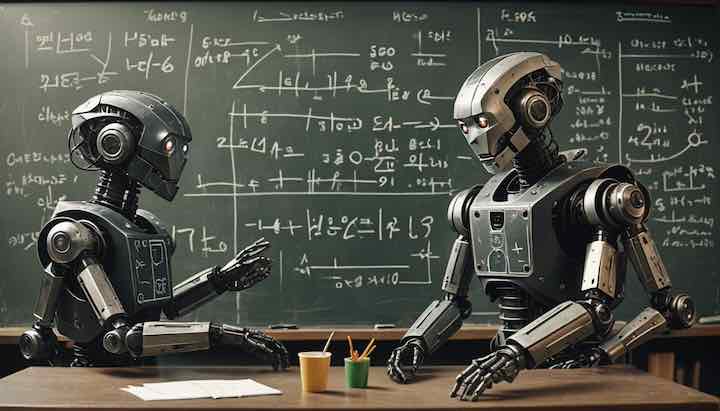
Artificial intelligence is another tool which is benefiting us in many ways, and has great potential to transform many aspects of life. (Dario Amodei of Anthropic describes AI models as “machines of loving grace”.) Yet we know there is a dark side to AI – it can be used for inhumane targeting in warfare, for deepfake porn and for political conspiracy theories. It seems now that we cannot believe any video, any photo, and sound bite, they could all be produced by AI.
When the internet, mobile phones, social media and AI are combined, the potential for both good and bad is enormous. The world won’t be the same, and is already very different from the world I grew up in.
Influence & control
Perhaps the most dangerous use of these technologies is in the influence and control powerful bad actors can now have over ordinary people.
Public opinion counts for a lot in most first world countries. Governments want to win votes. Advertisers want to sell products. Those with vested interests want to protect those interests. The rich and powerful want to stay that way, and the last thing they want is for the majority to vote to reduce inequality via taxation or legislation.
It has become clear that it is easier to retain power and position by demonising opponents and spreading misinformation, lies and conspiracy theories. People can be persuaded to vote against their best interests this way. Witness numbers of people who voted for Donald Trump because of misinformation, and are now feeling confused as prices rise because of tariffs and their social security is disappearing while a smaller number of people, including the president, profit.
And of course, the technology of social media and AI is a major factor in all this. And politics and government may never be the same.
So it’s no secret that our world is in darkness tonight.
…. and light
Reflecting on this darkness makes Jesus’ teachings more relevant. We can start to understand that Christmas isn’t just a sweet story of a mother giving birth despite adversity, or even the birth of an important religious teacher.
Jesus said his mission was nothing less than to bring the rule of God to earth. And his mother, Mary, foresaw the outcomes of Jesus coming to earth (Luke 1:52-53):
“He knocked tyrants off their high horses,
pulled victims out of the mud.
The starving poor sat down to a banquet;
the callous rich were left out in the cold.”
Of course it hasn’t happened yet.
But Christian belief says it will happen one day, when God through Jesus will renew the world and how the earth is organised, and so put everything right and bring justice to all.
And that’s not all.
Jesus calls his people to follow him (Luke 9:23) in bringing the rule of God on earth now by fighting injustice, being peacemakers and caring for the poor and downtrodden. Jesus thought this was so important that he said our place in the age to come would be dependent on whether we cared for the poor and sick and oppressed (Matthew 25:31-46).
And in the Sermon on the Mount (Matthew chapters 5-7) he shows us how to live to achieve that, by forgiving others as we ask God to forgive us, by responding to evil with good and responding to hate with love.
At their best Christians have made the world a better place in many ways – through hospitals, schools, social welfare, peace-making, generosity and hospitality.
But often, sadly, Christians have been quite the opposite – seeking power, fighting wars and oppressing minorities.
The corruption of Christianity
Religion can be a powerful force. And the last thing the rich and powerful want is for that force to be used to bring about greater equality. And so the powerful have often tried, and succeeded, in corrupting this revolutionary zeal for justice.
The church has often been used by governments to lend legitimacy to war (despite Jesus’ teachings on non-violence) – it happened in Britain in World War 1, George W Bush claimed God’s support for his “war on terror” and the Russian Orthodox Church supports the war against Ukraine.
These days, the church is in danger of being corrupted by the ultra-rich and fascist ideologies. We see this in the US where many churches and Christians have been persuaded to accept and adopt behaviours contrary to Jesus’ teaching on care for the poor, the outcast and the disadvantaged.
Some Christian leaders openly distance themselves from Jesus’ teaching, saying governments need to be stronger and less caring – but still repeat at Christmas Isaiah’s prophecy that “the government will be upon his shoulders” (Isaiah 9:6).
…. still shines
But the light of Jesus’ teachings still shines like a beacon, and he calls us to join the movement, be part of the rule of God, and make a difference. It is a simple and free process to join.
You may or may not believe in Jesus. But hopefully this Christmas you can at least know that the baby in the manger was born to “make the darkness tremble”, and his followers are called to do the same.
He gives us an ethic, a motivation and the power to get out and do it.
Merry Christmas!?
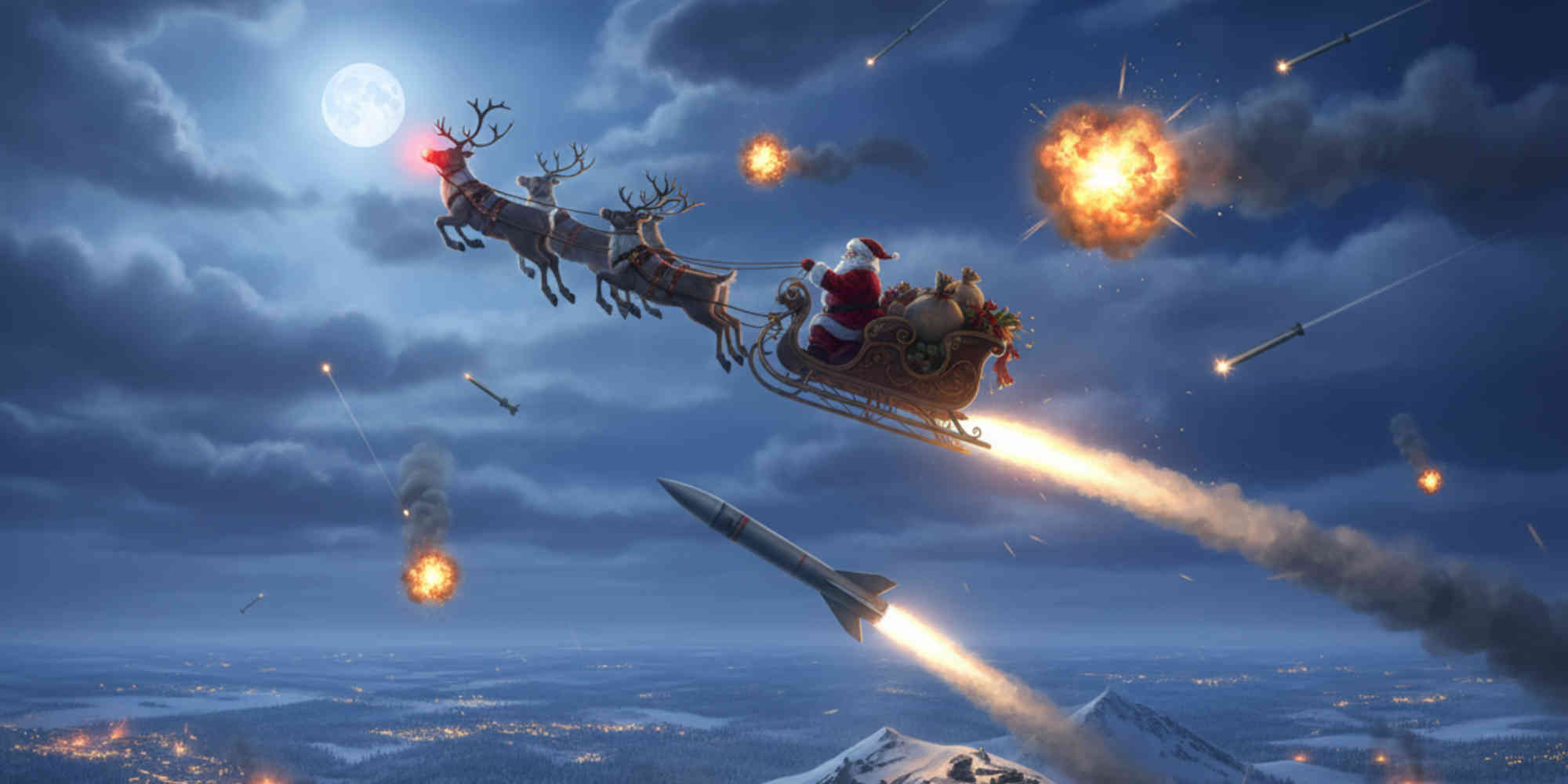
AI graphic composed on Adobe Firefly. Title from U2, The Fly, 1991