Having been challenged by a reader to critically consider the historical evidence for the life of Jesus, I began my own investigation.
It has been a while since I examined this question, and it is always good to update whatever I think I know. So this is what I found.
Background
The life of Jesus is recorded in the four Biblical gospels, and further details about him can be found elsewhere.
Critics of the New Testament and sceptics about the life of Jesus typically make claims along these lines:
There are no written sources contemporary with Jesus (i.e. written in his lifetime).
Jesus left no writings or artefacts behind.
The gospels are religious tracts and cannot be trusted as historical accounts.
The gospels are anonymous and not written by eyewitnesses.
You’d expect people other than Christians to mention Jesus, but almost no-one does.
Therefore either Jesus never existed or his life is so obscured that we can know nothing about him.
Are these statements true? Are they relevant? Do they show there is no reliable historical information about Jesus?
Let’s see.
Times have changed
It is obvious that the world of two millennia ago was very different to today, not least in the amount of information available. We are used to having ready access to information in libraries, books, newspapers and the internet. Once created, a document can be published, printed, copied and therefore a reliable copy is readily available. Online translators can help us
But in the ancient world, texts had to be hand written and hand copied, so they may contain errors. Few copies were available and they deteriorated with use. Many documents haven’t survived to today, or at least they haven’t been found yet.
So historians have to work hard to ascertain what actually happened.
Historical method
An approach has been developed (see refs 1-4) to try to ensure that the best possible reconstruction of events is made. This approach includes the following:
Identifying sources, including texts, inscriptions and artefacts.
Source criticism to identify possible biases and judge the extent to which a source can be trusted for information on the topic; matters such as date and place of writing, connection to eyewitnesses, provenance, authenticity, authorship and bias will need to be assessed.
Corroboration and triangulation involve comparing multiple independent sources wherever possible.
Contextualization: placing the source within its historical, social, political, and economic context and assessing its consistency with them. In the case of Jesus, this requires assessing whether sources written in Greek have an Aramaic (the language Jesus spoke) background.
Interpretation & evaluation: drawing meaning from the source, considering its limitations and biases.
These are obviously specialised tasks requiring knowledge of ancient languages and culture, access to sources, experience in making historical judgments, etc.
Knowing my limitations
I don’t have most of those skills, and it would be hubris to think I can assess sources myself. So I need to gather information from the best historians I can find, across a range of views.
This doesn’t take away my own judgment. I still have to choose who I believe are the “best” historians to learn from. And historians will inevitably disagree on some matters, so I will need to evaluate their biases (i.e. in effect do my own source criticism of them).
My chosen experts
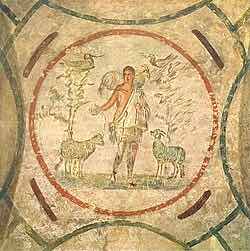
Jesus the good shepherd from Catacomb of Priscilla in Rome, 250-300 CE.
We all have our views about Jesus we bring to questions like this. It is tempting to just read historians from our own belief system, but I believe the better approach for me is to try to find a balance of non-believers and believers, with a slight leaning towards non-believers to keep me honest.
So my main sources are the late Maurice Casey and Bart Ehrman, both non-christians. Richard Bauckham has been my main Christian source and I have also read others of varying viewpoints.
I don’t like classifying scholars by their beliefs rather than their scholarship, but both believers and sceptics are so critical of each other that I feel I have to do this to claim the middle ground.
Sources for the life of Jesus
I suppose there are hundreds of ancient documents that refer to Jesus as a real person. Historians have to assess which if any of these give reliable historical information. Sources closest to the events are generally preferred.
Based on language, style, content and external references, scholars have concluded (with some disagreements) that about a dozen documents written in the first century give useful historical information about Jesus:
the letters of Paul – several documents, dated about 20-30 years after Jesus
other writings in the New Testament, dated 40-70 years after Jesus
the four gospels, dated about 40-60 years after Jesus
the writings of Josephus, dated about 60 years after Jesus.
In addition, a number of 2nd century documents give useful information:
historian Tacitus – early 2nd century
christian writers (e.g. Clement & the Didache)
brief mentions in Roman writers such as Pliny, Lucian
gospels & writings not included in the New Testament (e.g. the gospel of Thomas).
Assessment of these sources
Bart Ehrman estimates that there were about 30 separate sources for Jesus in the first century. Since these texts come from Christian, Jewish and Roman sources, and were written in different places and for different purposes, most historians (with few exceptions) have concluded that invention would have been impossible. Jesus was a real person. So the main discussion of sources centres around the four gospels in the Bible, as the only comprehensive accounts of Jesus’ life and teachings.
For a short outline of various views about Josephus’ references to Jesus, see box: Josephus and Jesus.
Josephus and Jesus
Romano-Jewish historian Flavius Josephus was born shortly after Jesus’ death, and lived through the time of the early Christian movement. He was active on both sides in the Jewish-Roman war of 66-73 CE. He wrote a history, Jewish Antiquities, in the late first century, which mentions Jesus twice. Copies of this work date from the tenth century (Greek), fifth century (Latin), tenth century (Arabic) and twelfth century (Syriac), and there are slight variations in the different versions.
One passage gives a short history of Jesus from an objective viewpoint, and more or less agreeing with the outline in the gospels. A few phrases seem too positive towards Jesus compared to Josephus’ known views and scholars have concluded that these phrases were added during copying by Christians. This conclusion is supported by the differences between the different language versions, which were made in different locations. Some Jesus-sceptics argue that the whole reference is an addition, but the diversity and relative independence of the copies, and the second reference to Jesus (see below) lead most historians to conclude that the core of the reference is genuinely from Josephus.
The second mention of Jesus is a passing reference to the “brother of Jesus the so-called Christ, whose name was James” when Jospehus was discussing the Jewish High Priest who had James killed. Few see any sign of a later christian interpolation during copying. A few sceptics argue that “brother” can mean “fellow christian” but these arguments haven’t convinced many.
And so the strong consensus of scholarship is that Josephus provides strong evidence of Jesus as a Jewish prophet, teacher and/or healer, although the exact wording of the original reference remains problematic.
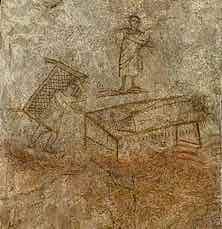
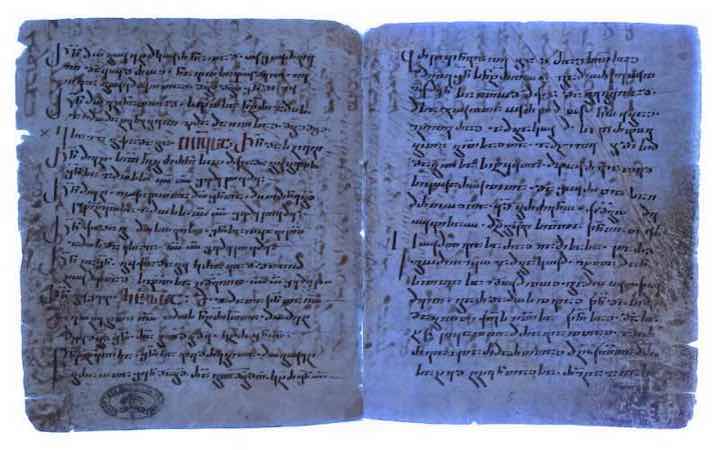
The four gospelsJesus healing the paralytic, Syrian city of Dura Europos, about 235 CE
Scholars almost unanimously regard the four canonical gospels as the earliest and most reliable accounts of Jesus’ life. Other “gospels” are dated much later and are of doubtful value for information about Jesus. (A few scholars consider the gospel of Thomas to be early, but most don’t.)
So how do historians assess the gospels?
Genre & purpose
The gospels are regarded as “biographies” of contemporary people. Ancient biographies were expected to be based on eyewitness testimony and were written to be a complimentary and edifying account of a person’s life and achievements. As such, they weren’t objective history, but their contents were selected to achieve their goal.
Luke (1:1-4) and John (20:31) say explicitly that they wrote to provide information to support belief in Jesus, and we can be confident that Matthew and Mark were written with similar purpose. This means historians have to take account of how this affects selection and wording of material. (This isn’t unusual as most ancient “histories” had some polemical purpose.)
Dating
There is a broad consensus that the gospels as we have them were written as follows:
Mark: 65-75 CE
Matthew: 70-75 CE
Luke: 80-90 CE
John: 90-100 CE
These dates are based mainly on an assessment of how they relate to the destruction of the Jerusalem temple in 70 CE, and event that would have been cataclysmic to Jews, plus an assessment of how each gospel may be dependent on others. Most scholars believe Mark is the oldest (some of the language is “cruder” and Matthew & Luke “improve” it), written either just before or just after 70 CE, depending on whether they believe Jesus did accurately predict the temple’s destruction (or it was a later invention) and how Mark reported it.
The dates for Matthew & Luke follow from the dating of Mark, using further comparisons of how the same events and teachings were copied or re-worded. John is universally recognised as being the result of long reflection on the life of Jesus, so it contains theology as much as history. Some scholars (e.g. Casey) consider it to be of little value for history but valuable for theology.
Jesus, mrual in catacomb of Commodilla, Rome, late 4th century.
However there are dissenting views from this consensus. Some push the dates back further, while others (including Casey) believe Mark and Matthew should be dated a decade or two earlier. Jonathan Bernier’s 2022 book is the most comprehensive analysis of dates I have seen, and it also supports Casey’s earler dates.
I feel Casey and others have a strong point, but I will stay with the consensus, with an open mind to Casey’s dates, and a feeling that the consensus may change a little in the future..
Authorship & provenance
This is probably the most crucial and interesting aspect of assessing these gospels as sources.
None of the four gospels include an author’s name, but they have been known by the names we know from early on. So scholars need to assess whether those naming the gospels in the early days knew more than we know now, and how the material came from the time of Jesus to the dates of writing.
Casey accepts that Marcus was likely the author of Mark, without it being clear who he was, the disciple Matthew was likely the origin of the gospel of Matthew, though not the final author/editor, and Luke was genuinely the author of Luke-Acts. Other scholars are less inclined to accept these identifications; some feel that few of Jesus’ earliest followers were literate enough to compose these texts. In the end, this may not be important either way, as we shall see.
From Jesus to the gospels
Careful analysis of the text of Matthew, Mark & Luke shows that some passages are similar, virtually word for word. It is clear that these passages have either been copied from the earlier gospel (Mark) to the later two, or they have all used the same written source(s). There are several ways this may have occurred, but the following seems to be the most accepted sequence of events.
1. Jesus the teacher
Like other rabbis, Jesus taught his disciples in ways that they could memorise his teachings. Scholars believe this is so because the gospels contain traces of the Aramaic language that was spoken in Galilee but not so much in the wider Roman Empire. At least some gospel accounts and sayings seem to go back to the time of Jesus and his very words – some sayings don’t make sense in Greek but are understandable when translated back into Aramaic.
It is possible, according to Casey, that Matthew, the disciple and former tax collector, was literate enough to write some of Jesus’ sayings down in Aramaic.
2. Jesus’ sayings
An early collection of sayings, sometimes called ‘Q’, was compiled in the Aramaic language, perhaps from Matthew’s writings. Some scholars contest this view.
3. People tell their storis
Those who saw and heard Jesus told their stories to others, and so some of these oral accounts became well known in some parts of the early church. Bauckham suggests, based on Middle Eastern oral cultures, that some of these stories would have taken on fairly set forms, with some variation around the edges in the telling. Other scholars, e.g. Ehrman, emphasis the likelihood that the stories were changed and developed in the telling, to meet the needs of the growing Jesus movement.
4. Mark
Eventually Mark, who hadn’t been a witness to Jesus, took it on himself to collect stories from various sources, perhaps including the apostle Peter, and translate them into Greek. Casey thinks the gospel we have wasn’t completed because there is no satisfactory ending and there are some pieces of bad translation from Aramaic into Greek which would have been corrected in editing. He dates it around 40 CE. Others believe it was written around 70 CE as the first generation of eyewitnesses was dying out.
5. Matthew
Shortly after, someone took Mark’s account and added the Q material to make a more compete gospel with slabs of Jesus’ teachings (e.g. the “Sermon on the Mount”) interleaved with Mark’s narrative, and added some specifically Jewish material. Matthew’s name was given to this document, perhaps because of his original association with the Q material.
6. Luke
Luke was an educated Greek who was supported by a rich patron in assembling his gospel. On his own account (Luke 1:1-4), he utilised and edited writings and reports from eyewitnesses and the next generation of readers, which seems to have included both Mark and Matthew.
7. John
John’s gospel is considered to be the last of the four to be written and some historians (e.g. Casey) think it tells us little that is historical. But von Walde has shown that John was at least familar with some of the geography of Jerusalem that was changed or destroyed in the period 40-70 CE, and so some of John must be based on older sources. I think it is fair to say that John is the most problematic of the four gospels, likely including both historical material and theological reflection.
8. Recognition
These four gospels were originally published in different parts of the Roman Empire, but by about the middle of the second century they seem to have been accepted as apostolic and valuable, above and beyond other “gospels” which began to appear.
So while the final writing of the gospels was probably not by eyewitnesses, the accounts go back to eyewitnesses only a generation before, and passed on mainly verbally in an oral culture, due to low levels of literacy.
All this analysis leads most scholars to the conclusion that while parts of Matthew and Luke are dependent on Mark or each other, there are actually quite a few identifiable sources behind the gospels.
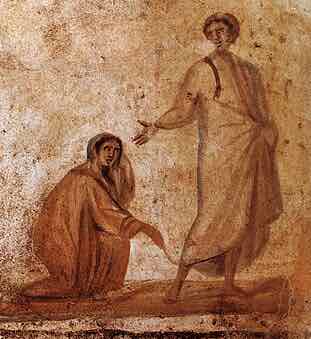
Hesus heals bleeding woman, Roman catacombs, 300-350 CE.
There is a reasonable amount of agreement about this general process, but divergence on how well, or otherwise, the material was transmitted from when Jesus spoke or acted to when the gospels were written down. That is a question for a different post. But regardless of the accuracy with which the accounts were passed down, there were at least half a dozen separate sources, making the life of Jesus well attested by ancient standards, even if some aspects are more problematic.
Evaluation
All this analysis leads most scholars to believe the gospels are excellent, albeit imperfect, sources for the life of Jesus. The balance between historical and less useful material varies with each scholar, but here are three conclusions.
Bart Ehrman says the gospels “are riddled with problems” because of bias and inconsistencies. He believes the stories were altered and added to during their oral transmission so that some events recorded never actually happened. Nevertheless he believes historians can separate the wheat from the chaff, and he concludes that we have numerous sources for Jesus, some dated within just a year or two of his life. “Historical sources like that are pretty astounding for an ancient figure of any kind.”
Maurice Casey has a slightly more positive view of the reliability of Matthew, Mark and Luke while still finding numerous places where the text isn’t historically reliable. He says Mark includes many “accurate accounts of incidents from the life of Jesus and sayings which he spoke”, translated into Greek, which he regards as “a massive achievement”. Matthew was “a remarkable person” who improved on Mark’s work and Luke was “an outstanding historian by ancient standards”. Casey doesn’t think John’s gospel is useful historically.
Richard Bauckham believes the gospels are substantially the testimony of eyewitnesses who weren’t disinterested observers. Their testimony was handed down in ways that preserved the essentials of the accounts while allowing variation in some details. And so the biographies that were eventually written down were a mix of history and interpretation.
Historical perspective
We need a historical perspective to assess how good or poor this evidence is.
It turns out that there are no comparable biographies for anyone in Palestine in Jesus’ day – not Pilate, not High Priest Caiaphas, not even Jospehus, though we do have Josephus’ writings, which are extremely valuable. So it can be said that the life of Jesus is far better attested than anyone living in first century Palestine.
In the wider world, some figures have biographies (or autobiographies) written about them in or close to their lifetimes – Julius Caesar and Augustus Caesar for example. But the latest surviving biographies of other famous figures (e.g. Alexander the Great, Hannibal, Cleopatra) are much longer after their lives than the gap between Jesus and the gospels. And many of these accounts contain supernatural events, exaggerations and apparent errors just as can be found in the gospels.
Bart Ehrman points out how exeptional the evidence is for Jesus, considering he was at the time an obscure figure in a distant part of the Roman Empire. He says: “There was widespread information about Jesus from the years after his death. Otherwise, you can’t explain all the literary evidence (dozens of independent sources), some of it based on Aramaic traditions of Jesus’ homeland. ….for Jesus, we have a wealth of material“
Assesing the sceptical claims
We started with a bunch of typcial sceptical claims about the evidence for Jesus. How do they stand up?
“There are no written sources contemporary with Jesus (i.e. written in his lifetime).” This is true, apart perhaps from the Q material included in Matthew. But this isn’t a very relevant fact since (i) the same is true for many famous figures whose existence nobody doubts, and (ii) the sources are very close to Jesus’ life and we have oral sources from Jesus time.
“Jesus left no writings or artefacts behind.” This also is true but also not unusual or unexpected.
“The gospels are religious tracts and cannot be trusted as historical accounts.” The gospels are biographies written with a religious purpose. Historians are trained to separate fact from religious belief. This process isn’t perfect, but it yields useful historical information.
“The gospels are anonymous and not written by eyewitnesses.” Authors names aren’t included in the text, but the traditions about authorship are early and may be true. They probably weren’t written by eyewitnesses (most history isn’t) but their sources go back to eyewitness reports.
“You’d expect people other than Christians to mention Jesus, but almost no-one does.” Actually historians wouldn’t expect most writers of the day to mention Jesus – their interests were elsewhere and he was an obscure figure. But what we have is pretty much exactly what you’d expect – only the briefest of mentions by Roman writers, a few negative references by Jewish writers, but copious enthusiastic writings by Christians.
“Therefore either Jesus never existed or his life is so obscured that we can know nothing about him.” This isn’t the conclusion of most historians who are familiar with the amount of evidence available for people of that time, and the amount necessary to establish details of someone’s life.
The Jesus mythicists want us to believe that there is a conspiracy of scholars protecting their positions to claim more for Jesus’ historicity than is justified – and so their evidence is biased. But they don’t seem to realise that the extremism of the sceptics’ claims leaves them open to a similar charge.
I’ll stay with the experts.
Conclusion
Jesus did exist.
We can be confident of certain details about his life. “We know who he was, what he did, what he taught, and why he died.” (EP Sanders)
Other aspects of his life and teachings are arguable.
The miraculous and his divinity remain beyond historical analysis and we are each free to decide what we believe about those claims.
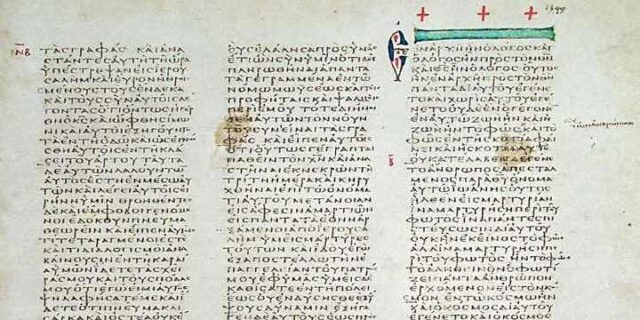
Codex Vaticanus, a fourth century manuscript containing most of the Greek New Testament and Old Testament. This page shows the end of the Gospel of Luke and the Beginning of John (Wikipedia). All other graphics are also from Wikipedia.