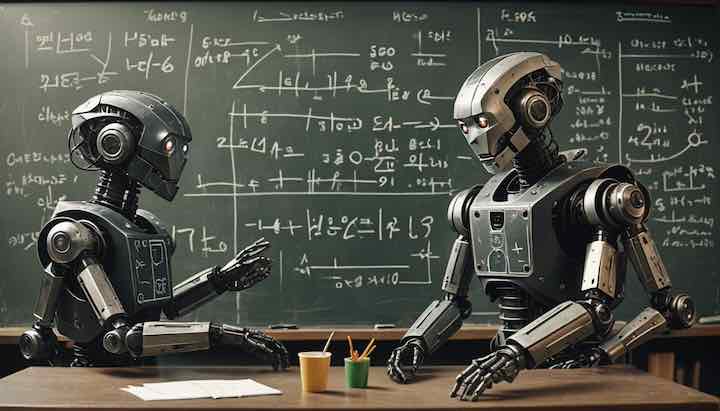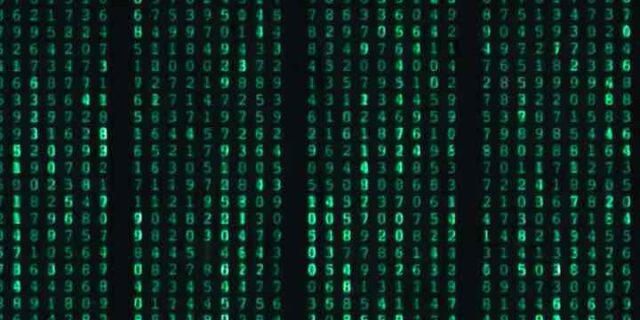
People have wondered as far back as Plato if life might be a dream. The 1999 film The Matrix brought into pop culture the idea of the world being a giant computer simulation.
As computer games become more and more realistic, it becomes easier to believe it might be true, I guess. And more recently some scientists and philosophers have started taking the idea seriously.
How would it work?
Most of us are familiar with the idea of a role-playing computer game. You play a character in a virtual world, sometimes exploring but often fighting. The graphics are increasingly realistic.
In a single player game, all the characters you come across, whether friends or enemies, act however the game programming makes them. But in a multiplayer game, there are game-controlled characters and characters controlled by other human players.
So could the world we live in and the life we experience be somehow like that? A vast simulated world created by some advanced civilisation. Perhaps we have no freewill. It may seem like we do, but maybe our feelings and consciousness might just be generated by the software and we just act as we are programmed.
In the computer game analogy, the characters on screen have no free choice. It is only us, sitting outside that world, who can choose whether our character will run or fight. So perhaps I am, or each of us are, currently lying in a virtual reality bed playing our earth-world character. It feels real to us because the programming is so good, but eventually we’ll “wake up” and go on living our real life in that world.
But if any of these options are true, who’s to say who that we meet is a real person and who is just a computerised character?
The philosophical argument
It is obvious that our computing, simulation and artificial intelligence techology is advancing at a rapid rate. Some philosophers argue that if a civilisation has progressed so far technologically that it is capable of creating large scale simulations including apparently conscious beings, then it is likely that many such simulations would have been created. And of course, living in such a simulation would seem real, that’s the whole point.
And so, it is argued, it is statistically more likely that we are in such a simulation rather than in a real universe that evolved conscious beings against the odds.
Proponents don’t believe this is an argument that proves we are living in a simulation. After all, maybe no civilisation has ever advanced that far, or maybe they have but didn’t have any reason to create a simulation like this. But, they say, it is a realistic possibility.
Scientific support
Some aspects of current science could be consistent with the simulation hypothesis.
- The world, according to quantum mechanics, isn’t continuous, but discontinuous and quantized at small scales, just like computer graphics.
- The physical laws that describe the universe are (in the main) simple and elegant mathematically, yet able to produce great complexity. The constants in the equations are finely tuned to allow galaxies, solar systems, stars and planets to form and life to evolve. As Fred Hoyle once said: “the facts suggests that a superintellect has monkeyed with the physics”.
- According to quantum physics, outcomes are not fixed until observed. This would allow much of the universe to not need to be simulated or rendered until observed, thus massively saving on computing power.
- Physicists tell us that matter isn’t solid as it appears, but the universe is more like information than material. This also fits with it being a computer simulation.
These facts don’t offer much evidence for the simulation scenario, but they at least show the the universe as we know it may not be inconsistent with it.
Arguments against
You won’t be surprised to know there are many arguments against this scenario being real.
- This is a philosophical argument with no evidence, and so totally unscientific, it is said.
- Since we are currently living in this universe, then the civilisation simulating our universe must exist in another universe. So first of all we need to show that other universes are likely to exist and evolve life. And the fine-tuning of our present universe suggests the existence of several universes favourable to life is so improbable that it negates the philosophical argument.
- Some scientists believe it is technologically unlikely to be able to program a simulation without some bugs becoming apparent, showing us that our world is unreal. Since our universe appears totally real, it can’t be a simulation. But against this, some scientists argue there are such glitches and inconsistencies in scientific observations.
- The amount of energy required to produce such a simulation would be physically impossible in our universe. Only a very different usiverse would be capable of it, and we don’t know if such a universe is possible.
- Two physicists have argued that creating such a simulation would require quantum computing, and they have shown that it is impossible to simulate a quantum computer. (I have included that argument for completeness, but I can’t say I understand it!)
- Some critics say the argument is close to magic or religion, which they say has no part in scientific discussion. But of course it’s not necessarily a scientific discussion.
What difference does it make?
Supposing we are actually living in a simulation, would that make any difference?
If we are living in a simulation, we have done all our lives or at least as long as the simulation has been running. So that’s life as we know it.
But the question is, if we knew the world is simulated, would it change how we view life?
I doubt it would change much. Many scientists and philosophers believe human actions are determined rather than freely chosen, but they also think we have to live with the illusion of freedom. And our laws, morality, philosophical reasoning and science all tacitly assume we are to some degree free agents, and most of us ignore what the scienticts and philosophers say.
So I reckon it would be the same here. A few smart people might believe in the simulation hypothesis but the rest of us would just get on with living.
But some say if we knew we were in a simulation, it might help us to understand what the game designers want us to achieve. (But how could we possibly know that?)
A reason not to believe it?
Others have suggested that if we knew we were in a simulation and acted accordingly, it might spoil the designers’ purpose and they might end the simulation.
God the simulator?
I find it interesting how many of the arguments for the simulation hypothesis work just as well, or better, for believing that God created our universe.
- The mathematical elegance of the physical laws and their fine tuning to allow life are often used as arguments for God as designer.
- The appearance of the universe as information, and the amazing information stored in our DNA, are also arguments for God behind it all.
- If understanding the game designer’s purpose would be useful, surely understanding God’s purpose in creating would also be important?
- Both hypotheses go beyond experimental science to reach conclusions by reason and probability.
Simulation or creation?
There is a lot more evidence (IMO) for God than for a simulation and much of the evidence for a simulation works also for God.
It’s a fun thought. It’s possibly true, we’re in a simulation, though unlikely. And I suppose it’s possible that God exists and we’re in a simulation.
But I can’t get too enthusastic about such a vague possibility.
But with the evidence for God so much stronger, I feel happy to build my life on that.
References
- Simulation hypothesis. Wikipedia.
- What Is Simulation Theory? Are We Living in a Computer Simulation? Built In.
- Why We Might Live in a Simulation: Arguments Decomposition. Breakthrough Science.
- Do we live in a computer simulation like in The Matrix? My proposed new law of physics backs up the idea. Melvin M. Vopson, The Conversation.