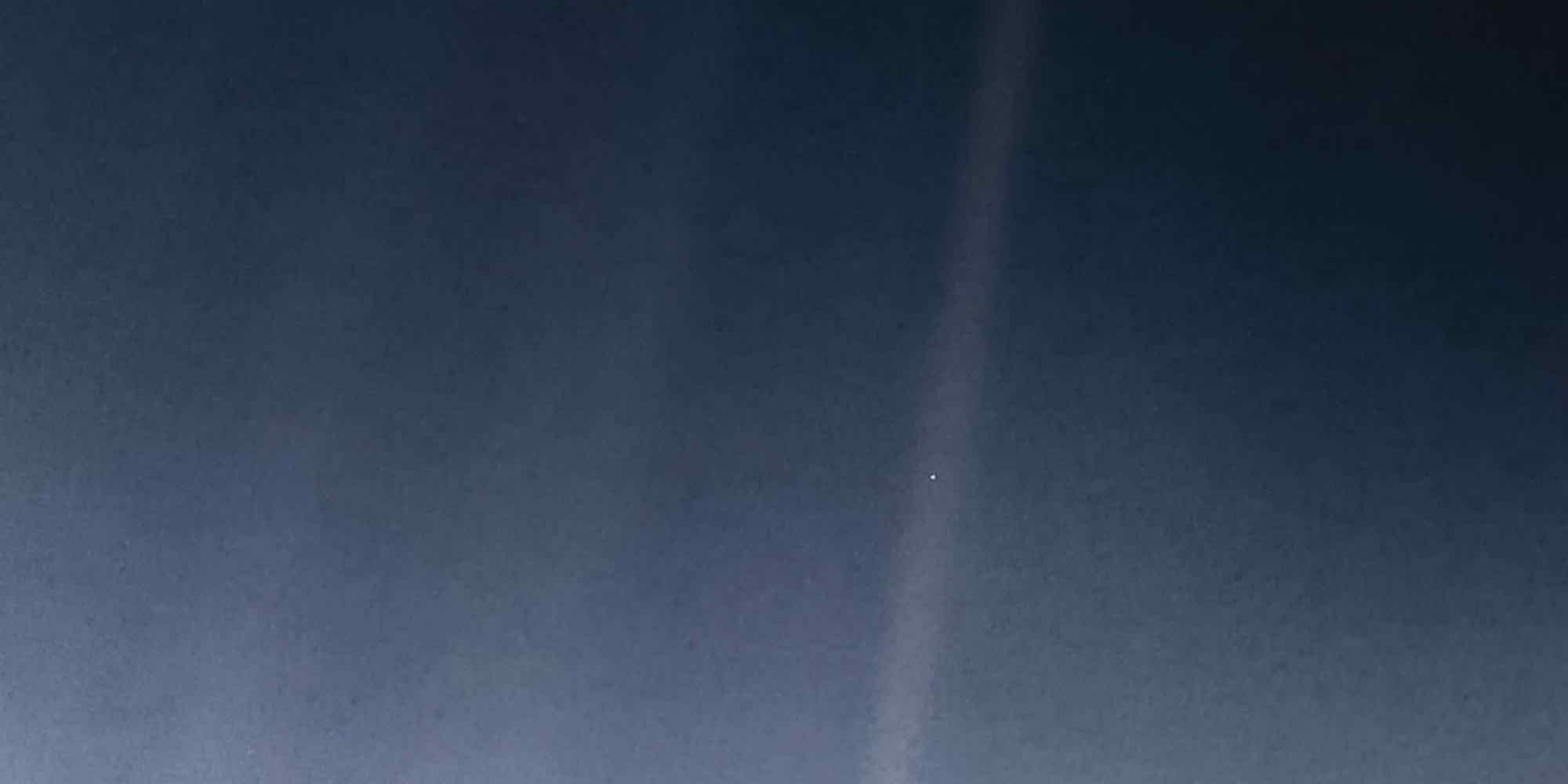
The small dot in the picture is earth, viewed from far out in space.
All of human history, every person’s life, the great achievements and works of art, the wars and the tragedies, all occurred on that dot (or for a very few people and days, on its moon that cannot even be seen here.)
I wonder how that makes you feel?
The Pale Blue Dot
Apparently people can react very differently to this photo. Some feel wonder, a sense of the majesty of space. Others see the fragility of earth and the urgent need to cherish and protect our common home and all its creatures. To see all creatures as kin and treat each other better.
But for many people, this photo evokes feelings of “cosmic insignificance“. A sense that our lives are transitory and ultimately meaningless.
It is easy to understand these different responses.
Wonder & majesty
Visit a farm away from city lights and you’ll see the stars like a city dweller never sees them. They are glorious. Kalahari Bushmen say they can hear the stars singing.
Or consider that there are likely a hundred billion galaxies, each one with something like a hundred billion stars. Our sun is one star in our Milky Way galaxy. The numbers boggle our minds and can cause us to marvel at the immensity of our universe.
The Jewish Psalmist wrote back more than two and a half millennia ago:
“The heavens declare the glory of God;
And the firmament shows His handiwork.
Day unto day utters speech,
And night unto night reveals knowledge.”
Astronomer Carl Sagan said: “…the magnificence of the Universe as revealed by modern science might be able to draw forth reserves of reverence and awe hardly tapped by the conventional faiths.”
So it is hardly surprising that some people see the pale blue dot of earth and feel a sense of awe.
The urgent need to cherish and protect
Most human beings seem to be programmed to care for the vulnerable. And so, it is understandable that seeing our earth looking so small and fragile would lead some people to feel the urgency of environmetal care and climate action, and wanting to care for family. So much else seems less important.
Carl Sagan again: “There is perhaps no better demonstration of the folly of human conceits than this distant image of our tiny world. To me, it underscores our responsibility to deal more kindly with one another, and to preserve and cherish the pale blue dot, the only home we’ve ever known.”
This is similar to the experience of astronaut Edgar Mitchell after he returned from walking on the moon: “You develop an instant global consciousness, a people orientation, an intense dissatisfaction with the state of the world, and a compulsion to do something about it. From out there on the moon, international politics look so petty.”
Cosmic insignificance
Contemplating the immense can make us feel small, and this can be terrifying for some. Joseph Conrad wrote in his novel Chance (1913) of “one of those dewy, clear, starry nights, oppressing our spirit, crushing our pride, by the brilliant evidence of the awful loneliness, of the hopeless obscure insignificance of our globe lost in the splendid revelation of a glittering, soulless universe.”
Blaise Pascal wrote of a similar feeling: “When I consider the short span of my life absorbed into the preceding and subsequent eternity … the small space which I fill and even can see, swallowed up in the infinite immensity of spaces of which I know nothing and which know nothing of me, I am terrified …. The eternal silence of these infinite spaces terrifies me”
But Pascal had other responses too, seeing such feelings as “the greatest perceivable sign of God’s overwhelming power”. This thought ties back to the Psalm quote earlier.
Philosopher Tim Bayne asks why does bringing God into the picture lessen the feeling of insignificance? Perhaps the English mystic, Lady Julian of Norwich, saw the answer in a vision of God:
“He showed me a little thing the size of a hazelnut, in the palm of my hand, and it was as round as a ball. I looked at it with my mind’s eye and I thought, ‘What can this be?’ And the answer came, ‘It is all that is made’.”
A believer in God can feel the immensity of the cosmos but still feel secure in God.
But does small = insignificant?
Tim Bayne has an interesting take on this. Suppose the camera taking the pale blue dot photo was capturing consciousness rather than the physical. Then our earth may have been the biggest object in the photo.
And then the human race might not be so cosmically insignificant.
Are we alone?
The feeling of cosmic insignificance hits home hardest if we believe we humans on that pale blue dot are truly alone in the universe.
But are we?
I have researched this question in Are we alone in the universe? The science of this is still very uncertain (and argued over!), but it appears that:
- There are a hundred billion galaxies in the observable universe, and maybe 100-200 billion stars in the average galaxy. That’s a lot of stars! (Maybe 10^22 – that’s 10,000,000,000,000,000,000,000.)
- There may be a similar number of planets, though only a fraction of these could possibly support life as we know it.
- There are probably planets in our Milky Way galaxy that are home to some form of simple microbial life, and many more elsewhere in the universe.
- But intelligent life is likely to be much rarer – perhaps nowhere else in our galaxy, and most likely spread far, wide and infrequently in the vast universe.
So we may not be alone, but other intelligent beings are likely too far away for us to know.
Awe and significance
Psychologists say a feeling of awe is good for our wellbeing. It reduces our self focus, helps us be kinder, and leads us to re-think what is important in life …. and much more.
So I wonder why some people find the pale blue dot photo evokes negative feelings and others find it evoking awe?
What about you? Please feel free to comment.
Main photo: The Pale Blue Dot – a photograph of Earth taken in 1990 by NASA’s Voyager 1 at a distance of 6 billion kilometers from the Sun. The earth was described by Carl Sagan as a “mote of dust suspended in a sunbeam”.
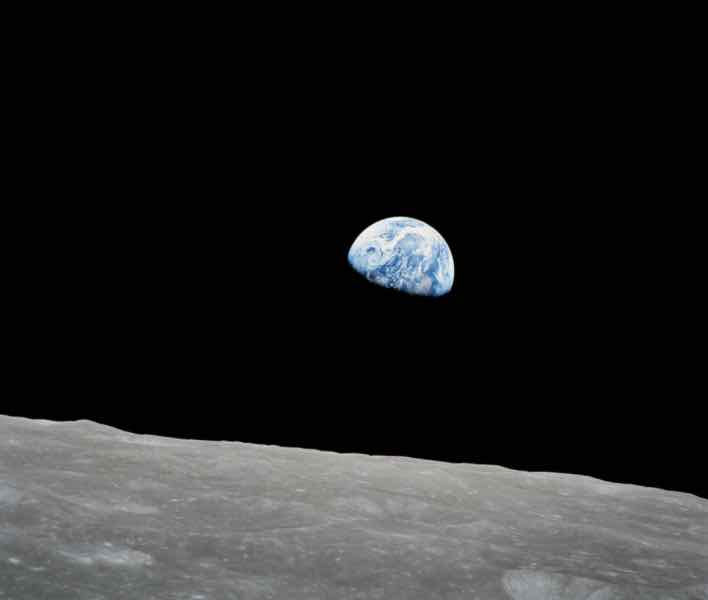
Earthrise photo by NASA.



Hi Eric.
Really enjoyed this one. I definitely don’t feel insignificance when I see pictures of the stars and our universe (I’m a massive nerd for that type of thing). Rather my mind wonders to questions such as “How is it possible? How could all this the laws holding it all together possibly exist? Let alone me?”. I definitely feel awe and humble, and often even hope that the universe as we humans understand that concept has meaning, even if it is (I suspect) incomprehensible to us biological mortals.
My two pence on alien life is as follows: The idea of Earth being the only thing in the Cosmos that can birth and sustain complex life is preposterous to me , but I’m deeply sceptical that we have ever been “visited” by aliens in spacecraft. In my opinion extraterrestrial life is all but certain, but I completely agree with you that they are simply too far away to confirm. If there is God, and I hope there is, it would make perfect sense to me that there has been life in the universe long before and long after humanity.
I’ll try and drop you a private email tomorrow (which is for me Friday and finally catch up with you.
Hope you and your family are doing well and are in good health Eric!
Aaron Rodgers.
Hi Aaron, nice to hear from you. I think many people get a thrill out of the vastness of the universe and the smallness of earth, but some find that exciting and some find it daunting.
As for alien life, I find it interesting the astronomers tend to see the huge number of stars and think other life is certain, while biologists tend to see the complexity of life and think it is very rare. It would be fun to think aliens have visited earth – but I wonder if the reality would be fun. Of course, maybe angels qualify?