I don’t want to destroy any illusions, but there are lots of things I don’t believe about Christmas.
But there are also a few things I do believe. Let’s strip away the negatives and focus on the positives.
Not part of my beliefs …
Sorry Virginia, but I don’t believe in Santa Claus. Of course I’m OK with keeping Santa as a children’s fairy tale, and I presume there’s a real story behind Santa – Saint Nicholas and all that – but he’s a poor replacement for Jesus.
I don’t believe in the “spend! spend! spend!” ethos that advertisers subtly try to sell us at Christmas (not to mention Valentines Day, Easter, Halloween, Thanksgiving, etc). Giving to the poor is more in the spirit of Christmas. Not so much “Ho! Ho! Ho!” as “No! No! No!”
I don’t really think Jesus was born on 25 December (the Bible never says so). That’s a later tradition.
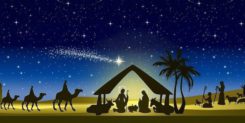
Lots of popular details are also later additions. There weren’t necessarily three wise men, just three gifts. As we shall see, Jesus probably wasn’t born in a stable, there probably wasn’t an inn, friendly or otherwise, and Mary probably didn’t give birth immediately she arrived in Bethlehem.
In fact historians question most of the details of the stories in Matthew & Luke – the Roman census, the wise men, the star and even the town of Bethlehem. Some say they were legends added, as was common in antiquity, to signifiy the importance of the person whose story was being told. But of course other historians accept a lot more as true. Me? I’m somewhere in the middle.
More important things I CAN believe
Isaiah’s prophecy
Isaiah 9:6, dated around 735 BCE, says:
For to us a child is born,
to us a son is given,
and the government will be on his shoulders.
And he will be called
Wonderful Counselor, Mighty God,
Everlasting Father, Prince of Peace.
This passage has been traditionally associated with Jesus, but modern day Jews contest this, saying the passage refers to king Hezekiah, and these names given to Hezekiah really refer to God, and certainly not Jesus.
But I think the Jewish understanding is quite compatible with the Christian view.
- Some ancient and modern Jewish sources apply the prophecy to someone other than Hezekiah, perhaps the Messiah himself.
- Properly understood, prophecies use figures of speech to try to present the mind of God. Taking them too literally (as some do) seems to me to be not recognising the genre.
- Rabbis in Jesus’ day often re-interpreted scriptural passages and prophecies to new situations not envisaged in the original text.
- This means that prophecies can have multiple fulfilments – e.g. one at the time of the prophecy and one at the coming of the Messiah (or even the second coming of the Messiah – a Christian belief but not a Jewish one).
So I can believe that Isaiah’s saying is indeed fulfilled in Jesus even if Isaiah didn’t intend that. I can think Isaiah’s vision is a wonderful one. I can only hope, pray and work for the day when the government will indeed be on his shoulders and he will indeed bring peace to this troubled world.
Luke’s story is very human and very believable
If we understand the words Luke used, the Christmas story fits with first century Jewish customs, and comes out like this.
It was arranged that Joseph and Mary get married. Whether Joseph was living in Bethlehem at the time, or in Nazareth, we don’t know, nor do we know how the families knew each other. Even though Mary was now pregnant, Joseph surprised everyone by continuing with the betrothal.
To formalise the betrothal, Joseph attended ceremonies in Nazareth, Mary’s home town, then took her on the long journey to his home town of Bethlehem. There they were married, with much feasting, and then moved into a small room attached to Joseph’s family home. [Middle Eastern hospitality would have ensured that they weren’t left begging at an inn. The word translated “inn” is better translated “guest room”.]
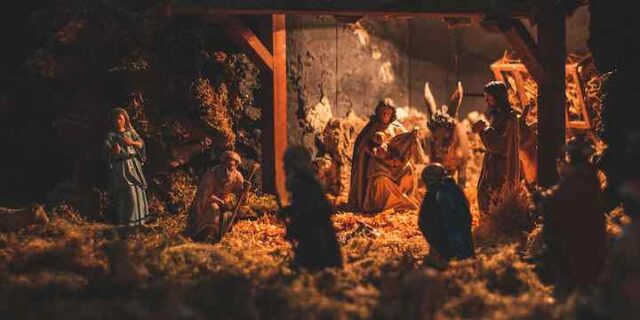
But the room was small, so when labour began, Mary moved into the main room and, assisted by family and midwives, gave birth to Jesus. The baby was laid in a manger because there wasn’t a lot of spare room. [In winter, animals might shelter overnight in part of the house, so an animal feeding trough would have been close by.]
The main objection to Luke’s account is the reference to the census by Quirinius. He apparently wasn’t the governor at that time, and there wasn’t a Empire wide census. But it does make sense that if Joseph’s family owned land in Bethlehem, he had to be there for some tax assessment purposes, and perhaps Luke misunderstood the nature of this.
Some argue that the birth in Bethlehem was invented to fulfil prophecy, or that Bethlehem in Galilee was confused with Bethlehem in Judea. Who knows? It doesn’t really bother me.
What’s important is that Jesus was born and grew up to begin to fulfil the prophecies of Isaiah and call us to join his movement.
Jesus makes a difference
Belief in Jesus can transform lives. I have whole sections of this website outlining encouraging stories of people whose lives entered a new level after finding Jesus.
It seems to happen again and again. Following Jesus isn’t just a nice idea, a religious ritual, a tradition or a delusion. It can lift a person right out of their impossible situation and give them hope, peace, healing, purpose and truth.
For one young woman, Christmas was the time it all began.
And here’s another story, of a man who received hope and healing through the light of Jesus.
I recognise that, sadly, it isn’t always that way. Some people gave God a try and feel he didn’t come through for them. Some have been traumatised by the church. If that’s you, I know my words can’t really make a difference, but I’m truly sorry for that. But I still believe Jesus can make a difference, even for you.
What’s essential, what’s not?
So this Christmas, I recognise the things I don’t believe, but am so much more encouraged by the things I do believe.
I hope your Christmas too is one of hope amidst this sad world.
Graphic: Burkay Canatar.