You, whoever you may be, are unique.
Like everyone else, your brain is capable of working out complex problems. You can fall in love or feel hurt, and you can remember things from long ago. But your DNA is unique, and you think and feel differently to everyone else. Each one of us has unique gifts, abilities, feelings and fears.
Yet all this happens in the 1.5 kg of our brains. Taken out of our bodies, it is just a lifeless lump of watery, fatty matter. Yet when we are alive, it supports all those emotions and thoughts.
How can that be?
Am I just my brain?
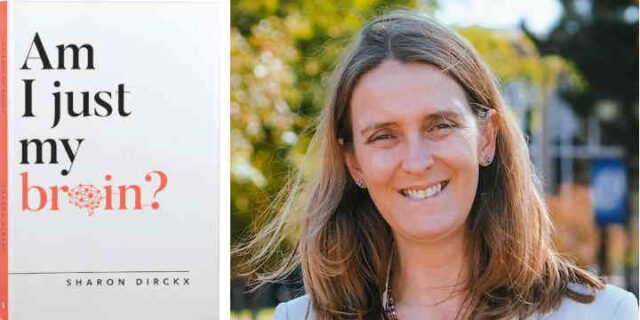
Neuroscientist Sharon Dirckx’s book Am I just my brain? discusses many of these issues. Her expertise is in brain imaging, specifically MRI (magnetic resonance imaging).
MRI uses magnetic fields to form images of the structure of the brain. Functional MRI (fMRI) can measure the movement of blood in the brain, thereby allowing brain functioning as well as structure to be measured.
For 11 years Dr Dirckx researched brain functioning of healthy adults, cancer patients and cocaine addicts. She is currently a Senior Tutor at the Oxford Cente for Christian Apologetics. Hence this book is philosophical and apologetic more than scientific.
Mind and brain
We can distinguish between our brains, which are physical places where electrical and chemical processes occur, and our minds where we think, feel and make choices. They seem to be two different things, but are they?
- Perhaps the mind and the brain are the same thing (reductive physicalism). Our feelings are nothing more than electrical impulses.
- Or maybe the brain produces the mind; perhaps the mind is like software running on the hardware of the brain (non-reductive physicalism). They are different but when the brain dies, the mind dies with it.
- A third option is that the two are different but related things (dualism). What happens in the brain affects the mind, but perhaps the mind can exist independently of the brain.
All views have their challenges and difficulties. A purely scientific approach might tend to favour #1 while human experience seems more like #2 or #3.
Sharon suggests we should resolve philosophical questions like this by asking 3 questions:
- Is it internally coherent?
- Does it have explanatory power?
- Can it be lived?
The book examines various aspects of these questions.
Is belief in the soul out of date?
The soul is an ancient idea. The ancient Greeks believed the soul is the essence of a person and can live on after the body dies. For some Christians, the soul is identified with our mind and emotions, and is immortal, and thus separate from our bodies (i.e. dualism). For other Christians, the soul in the Bible can be considered as our life and mind, and so isn’t immortal – our life in the next world depends on resurrection rather than immortality.
Many materialist critics see this idea of the soul as some sort of disembodied ghost and no longer believable. But their critics argue this view makes people no more than machines.
Sharon Dirckx says we thus get contradictory messages. On the one hand, we are no more than a body and a brain. But on the other hand, we are so much more than body and brain.
Which view is closer to the truth?
Are we just machines, or more than machines?
We seem to be more than just physical beings, but AI (which is clearly just a physical entity) can hold conversations that cannot be distinguished from a real person. So could all the abilities of humans arise from a merely physical creature?
One difficulty with this view is explaining our consciousness. AI chatbots can have a conversation like a human, but can they feel emotions, do they have senses? Can they know what it is like to be themselves, a being different to other beings? It seems not.
Hard core materialists believe consciousness doesn’t actually exist, it is just an illusion. But it seems few are willing to go this far; for these critics, consciousness is real and as yet unexplained.
Dirckx discusses various theories that attempt to explain how consciousness arises and is connected to the brain. How can we go from neurons firing to feeling like our unique selves?
- Materialists believe it is just a trick of the complex processes in the human brain. But, Dirckx argues, conscious experience is far richer than the brain states that apparently create it. Pain, which is experienced in our conscious minds, isn’t just an illusion.
- Some think consciousness is a fundamental quality of the universe, just like space, time and energy. The brain generates it, but it is more than the brain. Perhaps everything in the universe is conscious in some way.
- Others, including most Christians, believe consciousness exists because a conscious God created us to have consciousness too.
Is free will an illusion?
If physicalism is true and our minds are no more than our physical brains, how can we have free will? Our choices would be controlled by physical processes operating according to known laws, and there is no part of us outside those processes to change them. On this view, our brains are like machines or computers and all of our choices are determined by processes we have no independent control over.
There are scientific experiments that appear to support this view, but others that appear to refute it.
This is all debated by neuroscientists and philosophers. Some say we are free if our choices aren’t imposed from outside. Others say we may not be able to control thoughts arising in our minds, but can decide whether to act on them or not. For others, our human experience of freewill is stronger evidence than neuroscience that may undermine it.
Dirckx argues that determinism fails the three questions she believes are the test of an idea’s truth.
- It isn’t coherent because it would make all thoughts, including beliefs, a result of determined physical processes and so not based on reason. Including belief in determinism.
- It doesn’t explain human culture and autonomy.
- It isn’t livable because it undercuts ethics and human responsibility.
Are we hard-wired to believe in religion?
The majority of people in the world, even today, believe in a religion. How can this be explained?
There may be reasons in human evolution that explain religious belief.
- When animals or humans see unusual patterns in the natural world, it can help our survival if we are ultra cautious. It is better for a zebra to run away at an unusual noise just in case it is a predator. But this means our minds are programmed to believe in things that don’t necessarily exist. And so, it is claimed, religious belief may just be a widespread mistake.
- Others say that religious belief itself confers a survival advantage. Belief in a God who is watching us seems to make people behave more ethically. Religious belief tends to make people more altruisitc, at least towards others in their tribe or group. And so natural selection reinforces religious belief because it helps human groups to live cooperatively.
- Some say are genetically disposed to believe in God; we have a God gene. But it seems this idea has been disproved.
When people engage in religious activities (e.g. prayer or meditation), certain parts of their brains are active. Some types of brain activity (e.g. temporal lobe epilepsy) can be associated with religious experience. Some artificial stimulations of the brain can result in religious-like experiences. All this suggests to some that all religious belief can be explained by certain types of brain activity.
However all these things may or may not be true regardless of whether God exists or not. They could be God’s way of promoting belief, or they could explain religion without God.
How helpful is this book?
This book is a simple and short (150 pages) summary of a range of philosophical issues that arise from human experience combined with modern neuroscience. It covers some really important issues and gives sufficient references for us to follow up interesting matters.
I agreed mostly with her conclusions, though maybe not with her beliefs about the soul.
I was a little disappointed that there wasn’t a little more neuroscience – after all, this is her main expertise. But if you’re interested in these topics and haven’t read much on them before, this is an excellent introductory read.



Hi, Eric.
Out of curiosity, what is your position on the soul? If I recall correctly, you find the word unhelpful and not as biblically supported (in the Cartesian duelist sense of the word, which is actually only a few centuries old and is a modern era idea) as most people (Christian or secular) may think.
Was that right?
My own view is there isn’t a unified definition of the word soul (or even consciousness for that matter. No one even agrees on what consciousness is, let alone where it comes from), so I personally don’t like to use that term (soul) in theory of mind as it tends to be interpreted differently by different people, which can lead to misunderstandings.
Hi Aaron, yes, I feel too that the definition of “soul” is unclear, making the word less helpful.
In christian usage, soul is often seen as an immortal essence that lives on after we die. I don’t believe that. I believe our hope of life in the age to come is based on resurrection, not immortality. I think “psyche” in the NT means “life” not “soul”.
But I do think a material-only brain can’t explain human thought or free will, so I am a dualist or something close. If the non material aspect of our mind is a “soul” then OK, but I think a better word is needed.