Last post I outlined why I believe there must be a God, based on observations about the universe.
But what can observing the world teach us about that God?
Join me in a few tentative musings about some deep issues.
Four observations
1. It looks like it was designed for life
I argued last post that the very existence of a universe is hard to explain unless something non-material and timeless caused it.
But even harder to explain is the fact, explored by cosmologists over the last 50 years, that if the laws of physics were only a very little different, the universe likely wouldn’t exist at all by now (it would have collapsed in on itself) or it would have no solid bodies, perhaps made only of Hydrogen or Helium atoms.
And thus there would be no way that life could appear and evolve.
And so cosmologists conclude that of all the possible universes allowed by theoretical physics, the number that could produce life is vanishingly small.
It looks like it was designed for life.
2. And humanity appeared!
And life did indeed evolve, on earth at least, and quite likely elsewhere as well.
But human life is an enigma. Left to evolution alone, we could expect life to have the following characteristics:
- It would be efficient in terms of energy and effort. Natural selection would lead to there being no wasted effort. Yet human beings are conscious, aware of self, and introspective, all things that aren’t easy to explain in evolutionary terms because they don’t appear to be helpful for survival and reproduction.
- There is no morality in evolution. What is efficient in survival and reproduction is what is favoured – whatever is, is good. Yet human beings possess an inbuilt undertanding of morality, so that we have aspirations for something more than whatever is. Genocide may be the best strategy for survival in some situations, but we know it is wrong.
- Do human beings have the ability to make genuine choices, or is that an illusion? Universal human experience suggests that we do have genuine choice. Discussion of free will and other complex philosophical issues assumes we can make a decision based on evidence and logic and not just on what is determined by our physical brains.
What we observe and experience points to something beyond the physical, something in addition to biological evolution. It suggests to me that, not only did God design a world for life, but he or she designed human beings to be individuals, conscious, ethical, able to think rationally and able to make choices as a result. And able to love.
Which is suggestive that God may have the same (or more!) qualities.
3. So much pain, suffering and evil
But this conclusion seems to be at odds with the obvious fact that the world is full of misery, inequality, suffering and evil. Those things could easily be the result of evolution, but they hardly seem consistent with a supposedly good God.
We can see that some suffering is caused by people using their freedom of choice to oppress others or ignore their suffering. But we can’t help feeling that a good God could and should have made us a little less prone to misuse her gifts.
So if there’s a God, maybe he isn’t “good” in the way we define good?
4. Is God playing hard to get?
We can’t see God, at least most people can’t. If she wants us to believe in her, why not manifest herself around a little more?
And why are there so many religions, with different versions of God? Couldn’t he have made the truth a little more obvious, so seekers after him knew where to go, and what ethical rules or principles to follow?
So does God even care if we believe in her and follow her moral teachings.
Untying the knot
How can we resolve these apparent inconsistencies in what we observe in the world?
Let’s look at the strength of the inferences we have made about God and how the arguments relate to each other.
Which arguments are strongest?
My assessment is that the above four observations and arguments start with the strongest down to the weakest, because the earlier ones are more basic.
I mean by this that the later observations depend on the earlier ones:
- There can be no human race, no problem of evil and no hiddenness of God without a universe which exists and allows life to form.
- There can’t be a problem of evil without there being both a human race and an objective standard by which to judge something as evil.
So while the problem of evil and the hiddenness of God are problems to be considered, they depend on facts like the universe and the human race that make the existence of God probable (to me at least).
So what can we learn?
So if the latter two arguments don’t disprove God, what do they tell us about God?
How can we resolve the idea of a good and loving God with the evil we see in the world? Why doesn’t a good and loving God make himself more obvious?
Good and loving?
One easy way to resolve this conundrum is to conclude that God exists but he isn’t good and loving? But I concluded that the fact that the human race was designed to be ethical and loving (even if we fall short) implied that God had these qualities too.
So perhaps there is a different answer.
My feeling is that we have to modify how we see God’s love, in two ways:
- Whatever it is, God’s love isn’t soft and sentimental, but tough. I don’t understand why that is, but it seems like it must be true.
- A lot of the evil in the world comes because people behave badly – war, genocide, inequality, oppression, etc. God has made a world where we have the ability to make bad choices. She seems to value our autonomy so much as to allow bad and harmful choices. Again, I don’t understand that, but it seems to be the case.
This is a solution, but a rather terrifying one. Is giving humans the dignity of the amazing gift of autonomy and (to some degree) self determination really worth all that suffering? I’m drawn to thinking that must be true.
Hidden?
Human autonomy seems to be a factor here too.
- A world where God is less obvious allows us to have real freedom (no-one drives over the speed limit when a police car is nearby!).
- A world where God is less controlling allows us the autonomy to develop our own characters.
- And a world where God doesn’t make his requirements totally obvious means we can’t so easily obey out of fear and do the absolute minimum to get by. Instead, we are free to act in ways that make our motivations clear.
So I can’t help concluding that God is more interested in character and motivations than pedantic obedience or belief for belief’s sake. She asks for our belief because she wants to begin a relationship with us based on love and trust, not just because she values faith in itself.
Two confirming facts
These feelings are reinforced in my mind by two extra observations:
Jesus as a picture of God
It would be easy for most people at most times and places in history to conclude that God isn’t loving or good. But if Jesus truly represented God on earth and showed God’s character (as I believe), then this confirms that despite the suffering and pain, God is indeed with us in the pain (whatever that means) and is good.
We need that reassurance, and I believe God has given it to us.
People experience God?
There is good evidence that some people experience God, through healing, guidance, visions, a sense of purpose and lives turned around (I have written up many of these stories in Life: hope, healing & happiness).
God may remain hidden for many of us, but certainly not all. I wouldn’t pretend to understand why the difference, but the experience of those blessed with God coming near to them strongly suggests to me that God is loving, caring and good.
Above & beyond
These matters are really above and beyond my ability to resolve with any real confidence.
But I can’t help thinking about them and wrestling with how to resolve these difficult observations.
I hope they encourage you to delve further too. Please let me know what you think.
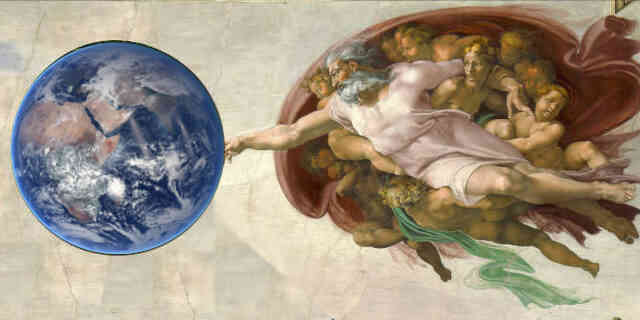
Earth photo by NASA. God graphic by Wikipedia.