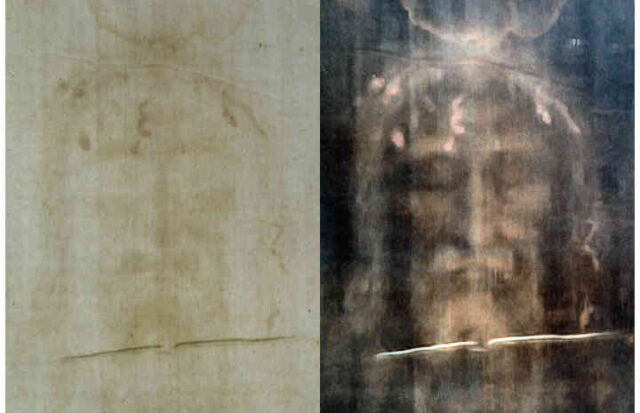
The Turin shroud is a famous piece of cloth which is claimed to have been Jesus’ burial cloth, and contains an image of him. Sceptics say it is a medieval fake.
Is there any way to decide who is right?
Hundreds of articles and research reports have been written on this topic. It would be impossible to read them all, but I have done my best to get on top of all the issues and viewpoints.
Declaration of personal interest
I am a Christian who believes in the resurrection of Jesus. Thus the proposition that the Turin shroud was Jesus’ burial cloth, and that it might have been affected by his resurrection, is one I am able to believe if the evidence points that way.
On the other hand, I am not a Catholic. I think the interest of some Catholics in holy relics is somehow not in keeping with the life and teachings of the Jesus of history, and I am uncomfortable with some of the more extreme claims about relics.
I therefore come to the Turin shroud with a degree of scepticism but with an open mind.
I originally researched and wrote this evaluation in 2015. This page is an update, so I have included dates on the most recent information. The 2013 review by Atle Søvik which has guided my conclusions is now 12 years old, so I have updated my conclusions, but have still been influenced by his assessment.
Facts about the shroud
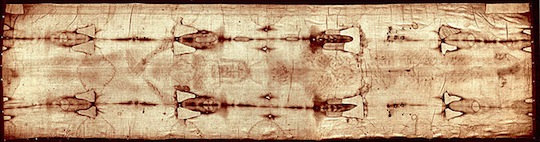
The shroud is a piece of linen cloth about 4.4m x 1.4m. (Linen is a material made from flax.) It contains the front and back image of a man who appears to have been injured in the way the New Testament portrays Jesus was injured at his crucifixion. The image is more visible when viewed as a photographic negative.
It is claimed by some that this is the actual burial cloth of Jesus and it bears his inmage. It is often claimed that the image was made when Jesus was resurrected by God’s power.
The shroud is first known to have existed in 1355, and its whereabouts are known since that date. Before that, there are some possible references to it, especially if it is the same object as the Image of Edessa, another ancient shroud whose history is better known, but this is uncertain.
Many Catholics over many centuries have believed it is a holy relic, though the church is noncommittal on this. Much scientific testing was done by the Shroud of Turin Research Project (STURP), a multidisciplinary group that operated from 1977 to 1981, and by numerous scientists since. STURP apparently contained sceptics as well as Jews and Christians, but is much maligned by sceptics.
Arguments in favour of the shroud’s authenticity
The arguments for the shroud’s authenticity form a cumulative case.
1. The shroud is ancient
- Vanillin is a compound found naturally in plants, including the flax used to make linen. After the plant is harvested and made into cloth, the vanillin slowly depletes. The shroud contains no vanillin, and one set of very approximate tests suggests it must have been made before 700 CE. However, critics dispute the method, which they say was qualitative when a more precise method, and the equipment to perform it, were readily available.
- Two different forms of spectrometry (infra red and raman) can estimate age based on the chemical composition of a fabric, which changes over time. These methods dated the shroud to the period 700 BCE to 300 CE, most likely around 250 BCE, much earlier than the dates obtained by disputed radiocarbon dating.
- The strength of fibres also varies with time, so mechanical testing can indicate age. This test dated the shroud in the range 0 to 800 CE.
- In a 2022 study, X-Ray scattering was used to measure the age of flax cellulose in the shroud. Comparing the results to similar material of known ancient age, and making plausible but uncertain assumptions about the temperature and humidity that the shroud had been kept at, a date in the first century CE was estimated for the shroud. This is probably the most reliable for these method five methods.
These 5 methods all point consistently to an early date for the shroud. However radiocarbon dating indicates a medieval date (see below). It is arguable whether the cumulative value of these less recognised dating methods is enough to negate the carbon dating.
In addition, the shroud has an unusual seam that has only been seen in a first century cloth. It appears to have been cut from a larger piece, of a size made in Roman times but not in the Middle Ages.
2. The shroud originated in first century Palestine
- Some experts have found pollens on the shroud that originate in Palestine. This evidence is questionable but probably reasonable.
- Studies of isotopes of hydrogen and oxygen in materials from around Europe and the Mediterranean show three groups – Europe, the western Levant (modern Israel, Palestine, Lebanon) and Egypt. A 2024 report on the testing of isotopes in the linen material of the shroud reported that the results placed the shroud in the western Levant group. However critics say that the shroud results fall in an area where European and western Levant results overlap, thus not clarifying where the flax was grown.
3. The image contains blood
Those supporting the shroud’s authenticity say tests indicate the shroud contains human blood (a claim contested by sceptics, who argue it is paint):
- The blood has soaked into the material, as you’d expect, whereas the image is only on the surface. If both were paint as claimed by sceptics, you’d expect them both to soak in the same amount.
- The chemicals you’d expect to find in the blood are found in the “blood” on the shroud. In particular, bilirubin, which is high in the blood of a person who has suffered extreme trauma, is found on the shroud.
- The serum from the blood on the shroud makes small rings around blood stains, visible in UV light but not visible to any painter in the Middle Ages.
- One researcher found evidence of vein and arterial blood in the right places, something not likely to have been known by medieval artists.
- Other researchers found evidence of DNA and even a blood group (AB – though old blood often has decayed to appear as AB).
Most of this evidence is older, and perhaps of questionable value – the blood may not even be human. But a more recent (2024) paper provides a summary of evidence for the presence of blood and argues for it indicating death by crucifixion.
4. The image looks like a person crucified by the Romans
It is argued that the image must have been made by a body (certain features could not have been merely painted) and this person was nude and had recently been whipped, crucified, stabbed in the side, all things common in Roman executions.
- In 2001 Dr. Robert Bucklin performed an autopsy based on the image on the shroud. He found evidence of lines on the back consistent with whipping by a Roman flagrum (a whip with three leather straps tipped with lead balls) and a large bloodstain consistent with the would in Jesus side froma Roman spear, as described in the gospels.
- A 2017 forensic study and a 2022 paper by a neurologist supported the view that the person wrapped in the shroud died in a similar manner to Jesus.
- A 2017 study of micro particles from the feet area of the shroud found blood with creatinine and nanoferritin, which indicates the blood came from a person who had suffered torture or other severe trauma, consistent with crucifixion. However this paper was retracted and the results are uncertain.
5. Gospel details
The four gospels give slightly different details about the wrappings around Jesus’ body. John mentions “strips of linen” and “wrappings”, Mark and Matthews only mention “a linen cloth”, while Luke uses both terms. If we assume there was a larger cloth and smaller wrappings, the shroud could be the large cloth and thus consistent with these details.
John’s gospel also mentions a separate “face cloth”, which at first sight appears inconsistent with the shroud, which shows a face on the large linen cloth. But apparently the face cloth was a preliminary wrapping, to ensure all blood was buried with the body and the preserve the dignity while the corpse was in public view,and sometimes later discarded when the larger wrapping was put in place. It has been argued that the Sudarium of Oviedo (see #10 below) was in fact this face cloth, thus explaining the similarities of the bloodstains on the two relics.
Finally, all the gospels say that Jesus’ body was anointed with spices. Different reports have found, or not found, evidence of spices on the shroud.This paper argues there is sufficient evidence to show that the shroud definitely was a funerary cloth.
6. Features that were uncommon, but true of Jesus
- The image shows wounds that look like the crown of thorns reported in the gospels, but unknown in any other Roman execution.
- Crucifixions generally involved common criminals, who would not normally have been wrapped in an expensive cloth like this.
- The body was only wrapped in the shroud for about 30 hours – if it had been longer, decaying processes would have begun, but these are not evident – which would be unusual, but fits with Jesus being resurrected after that time.
7. The image is more like Jesus than medieval people knew
The image shows signs of a number of features of Jesus’ crucifixion that we understand today, but which were not understood in the Middle Ages.
- The nails were hammered into different parts of the body that usually depicted in Medieval times, but now known to be correct.
- The whip marks appear consistent with the use of a Roman flagrum by two different people. It is argued that the shape and pattern of wound left by these whips was not known in medieval times.
8. How was the image formed?
It wasn’t painted – the image is just on the surface, and hasn’t penetrated into the fibres as paint would have done – and it didn’t come from radiation.
While some sceptics have suggested ways the image might have been formed, it is claimed that no explanation is physically, chemically, biologically and medically sound, and no method has been proposed that was within the capabilities of medieval forgers.
One suggestion by shroud “believers” is a Maillard reaction. This occurs when soap herbs used in the manufacture of the lined form a thin layer on the surface of fibres, and then react with amino acids released from the body shortly after death, creating brown marks similar to what is seen on the shroud. But critics say the image is too high resolution for this.
The lack of a natural explanation has led some to claim the image was formed during a release of energy when Jesus was resurrected, but I have seen no real explanation of this process.
9. The Pray manuscript
A manuscript dated about 1192 contains a picture of an object that looks like the shroud and shows many minor details which are exact copies, suggesting the shroud was in existence more than a century before the generally accepted date, and earlier than sceptics believe it was made.
10. The Sudarium of Oviedo
There is another artefact, apparently a cloth that covered a dead man’s blood-stained face, reportedly removed from Palestine in the early seventh century. Similar arguments have been made for or against its identification as the cloth that covered Jesus’ face. Most interesting is the fact that blood marks on this cloth match those in the facial area in the shroud.
Since this cloth is almost certainly older than the sceptical dating of the shroud, it is arguably further evidence of the authenticity of the shroud.
Summary
It is argued that all these evidences show that the shroud once covered the body of a man crucified by the Romans in the Middle East around the first century, in a manner which makes it unlikely that it could have been anyone other than Jesus.
Arguments against it being genuine
Sceptics contest many of these claims, but base their scepticism mainly on carbon dating.
1. Problems with the cloth
It is argued that some features of the cloth – its 3-1 herringbone pattern and the thread spun with a clockwise twist – don’t indicate a first century date, but a medieval one.
2. Not all the claimed features are clear
Proponents have claimed that the image shows wounds from crucifixion, whipping, crown of thorns, coins on the eyes, the man was circumcised, etc, but not all these are as clear as claimed, and are open to interpretation.
3. Paint and no blood
Contrary to STURP, sceptics say that the image could have been painted (with the paint now worn off leaving only traces of impurities), and there are no traces of blood on the fabric, but rather iron oxide. Microsopist Walter McCrone, once a member of STURP, was especially convinced that the appearance of blood was actually pigment. Critics said he used outdated methods to establish this.
Experiments have shown that a plausible image can be produced by placing a cloth over a person and rubbing with pigment and then baking the cloth to simulate aging, although critics say the image is not really comparable, and it shows the image where the body was in contact with the cloth, whereas the shroud shows the image where there was no contact.
However it seems that in the most recent papers, sceptics mostly accept there is blood on the shroud – the question now is rather whether the blood stains indicate a crucified man.
A 2018 paper reports that forensic experiments show that the much blood appearing on the shroud is not in patterns that would have been produced by a body lying horizontal while being wrapped in the shroud. This suggests the blood was put on the shroud, perhaps by painting blood on a live person and then wrapping the shroud around them.
This paper has been criticised by opponents and defended by the authors.
4. The accuracy of the image
- The proportions of the image are anatomically wrong, and don’t fit a man lying down with a shroud draped around him (such an image should be larger than a front-on view). However the proportions couldn’t be wrong if the image was produced by rubbing pigment over a person draped in the cloth.
- The hair appears to have been hanging down as if the man was standing rather than lying, and it isn’t caked with blood as you’d expect.
- A graphics expert said recently (2024) that the image on the shroud doesn’t look as if it was produced by a 3 dimensional body. A 2-D figure would produce an image more like the shroud’s.
5. Carbon 14 testing
The strongest evidence for medieval dating is a set of carbon 14 tests done at three separate laboratories. The original testing protocol was for two different types of tests at 7 laboratories on samples from different parts of the shroud, but a church official reduced this to one test at 3 laboratories on samples from one corner only.
The tests dated the shroud at between 1260 and 1390 CE. This time-frame matches the earliest documented “discoveries” of the cloth and coincides with a time period in which a lot of holy relics were being manufactured. If these test results are correct, obviously the shroud is medieval and can’t be genuine. This is the strongest argument against authenticity.
However shroud supporters present a number of arguments against these dates.
- Carbon 14 dating has been found to be in error in other artefacts from antiquity.
- The samples were taken from a corner of the cloth that had been repaired in the middle ages, and so were not measuring the age of the main part of the shroud. It would have been highly incompetent if the material to be radiocarbon dated was taken from a patch, and no-one recognised it, so this argument requires validation.
- Vanillan testing confirmed that the shroud is older than that, and that there are indeed two different linen fibres one medieval and one much older.
- Infra red spectrometry and other tests indicate a much earlier date.
The matter could be resolved by doing more complete radiocarbon testing, but so far the church has been unwilling to allow this.
6. Why wasn’t it mentioned in the early church?
John’s gospel mentions the cloths left behind in the tomb, but there is no mention there, or anywhere else, of a gravecloth bearing Jesus’ image. If it really existed, it is hard to imagine that no-one would have mentioned it.
However it is worth noting that Jesus’ tomb wasn’t venerated until much later – they just didn’t seem to be interested, since they believed Jesus was alive. So perhaps the shroud wasn’t of interest until later.
Nevertheless, the silence from the first century seems to throw a lot of doubt on authenticity.
7. It could be a person other than Jesus
There is no absolute identification with Jesus. However the crucifixion of Jesus is the only time there is any record of a crown of thorns being placed on a victim. And if it was actually Jesus’ burial cloth, there would be a much stronger motivation to preserve it.
9. The shroud doesn’t prove Jesus’ resurrection
Even if the shroud was genuinely used to wrap Jesus’ body, it doesn’t prove Jesus was resurrected.
Some people have suggested that the image was formed by a burst of energy when Jesus was resurrected, but I have not seen any plausible explanation along these lines. Thus the shroud isn’t directly evidence of the resurrection, though if genuine, it would establish (against Jesus mythicists) that Jesus was a historical person who really was crucified.
How can a neutral person judge?
This is only a small summary of the evidence for and against the authenticity of the shroud. There are many, many peer-reviewed papers and internet articles – for example, this paper gives 76 references on the shroud and art history alone.
The pro-authenticity group seems to have produced far more evidence and analysis, and more peer-reviewed papers, than the sceptics. This is understandable, for they are likely more motivated (e.g. they have set up conferences, groups and websites in support of their views), but it means sceptics tend to rely on the same few expert opinions while their opponents have much more ammunition. The challenge for an independent reviewer is to be influenced by quality, not quantity!
How can an outsider sort through the information? With so many conflicting claims, who can we trust?
STURP and the ‘believers’?
Scientists who support the authenticity of the shroud have published many papers in peer-reviewed journals. These papers are presented in a sober fashion as befits such journals. However they are accused of having made their minds up in advance, presumably (though I don’t know) because most of them are believed to be Catholics.
I have no evidence of bias, but clearly they have a viewpoint that is no longer disinterested. This group’s evidence must be carefully considered, but an impartial person couldn’t take this evidence on its own.
The sceptics?
The sceptics too have their viewpoint, and there are good reasons why an impartial reader cannot accept this view without question either. They have published far less in peer-reviewed journals, all their arguments appear to have been answered by the ‘believers’, some of their writings make unscientific slurs against their opponents (Schafersman uses words like “pseudoscientific”, “hopelessly incompetent” and “unscientific, nonsense-mongering”) and they claim much greater certainty than their evidence merits, which suggests serious bias.
This group’s evidence must also be seriously considered, but an impartial person couldn’t take this evidence on its own either.
Review by Atle Søvik
With both sides seemingly more interested in supporting a viewpoint than discovering the truth, I was fortunate to come across a 2013 review of both sides of the argument by Atle Søvik, a Norwegian Philosopher of Religion and Professor of Theology. His review is based mainly on published peer-reviewed papers, and is found in a main paper and a supporting paper.
It may be thought that a Professor of Theology isn’t an impartial observer, but I believe this is the most balanced assessment I have come across, because he is an academic, he seems impartial and reliable, it is in a peer-reviewed journal, he is not Catholic and he is likely a liberal christian who isn’t as strongly biased towards supernatural explanations as a naturalist would be biased against them. I am strengthened in this conclusion after brief correspondence with a sceptical member of the team that reviewed his paper before publication..
Søvik draws the following conclusions:
- There is blood on the shroud, and it was there before the image was formed.
- The image wasn’t painted. No-one has been able to create a similar image. The image is from a crucified man.
- The image is either that of Jesus or created to look as if it was Jesus.
- There is much evidence of an early date for th shroud. The radiocarbon dating is the only strong argument for a medieval date. If correct, the matter is settled.
- But since the radiocarbon dating is uncertain, the remaining evidence points to the shroud being genuine.
This assessment was made more than a decade ago, and many studies have been competed since then. So I take Søvik’s evidence as being fair at that date, but in need of being updated.
My assessment
There are a series of questions we can ask about the shroud. Unfortunately, I can’t see how many of them have been answered definitively.
1. How old is the shroud?
There is good evidence for both an ancient and a medieval date. Until a new set of radiocarbon dates are obtained, we have to simply say that any date in or near the first millennium CE is possible. New radiocarbon testing is the single most important information to assist in resolving the shroud’s genuineness.
However even if the date is ancient, that doesn’t necessarily mean the image is ancient.
2. Where does then material come from?
It seems most likely the cloth was created in the Middle East. But this doesn’t necessarily mean the image was also created in the Middle east.
3. Is the image formed by a crucified man?
There are many details, some of which wouldn’t have been known to a medieval artist, which suggest the image is of a crucified man. However there are also details that suggest the bloodstains were created by an artist, not by the wounds of a crucified man.
4. Is the man Jesus?
It is possible that the image is of someone else, but there are enough unusual details to suggest it was more likely either an image created by Jesus’ body, or intended to look that way.
However the lack of any mention of the shroud until centuries after Jesus’ death, and no provenance for the shroud until a millennium afterwards make it difficult to assign it to Jesus.
5. How was the image produced?
Whether produced by a corpse, a resurrection, or an artist, no-one can explain how the image was formed, or reproduce it. It doesn’t seem to have been painted in any way.
6. So is it a fake?
I think neither side has proved their case or shown the other side to be wrong.
The authenticity case has more studies and better evidence than the sceptical case, but I’m not fully convinced:
- both sides seem motivated to prove their viewpoint, making it harder to trust the authenticity information;
- until the radiocarbon dates are definitively confirmed or disproven, it’s not really possible to fully believe; and
- such a specific and amazing claim requires positive answers to several questions, which means multiplying the probabilities, and it seems a bridge too far.
By comparison, the sceptical case is not nearly so well supported, and relies mostly on incredulity ….. and the radiocarbon dating. Until the sceptics can show how the image was produced, I can’t support their conclusion./p>
So I don’t think we can be confident either way, but I remain mildly sceptical.
My mild scepticism is reinforced by an innate doubt that God would work in this way – after all, Jesus refused to use spectacular signs to authenticate himself. I cannot remove from my mind the many other relics, some of which are quite impossible, and some of which (e.g. non-decaying saints) seem quite superstitious.
If only the radiocarbon and other testing could be re-done by agreed best methods, we might get a better answer. In the meantime, both believers and sceptics would do well to avoid making over-strong claims.
References
Neutral references
- Shroud of Turin Authenticity: 9 Fascinating Facts & Debates. History Hidden, 2025.
- Is The Shroud Of Turin Real? Here’s What The Evidence Says. Austin Harvey, All that’s interesting, 2025.
- Wikipedia on the Shroud of Turin and the Sudarium of Oviedo. I have included Wikipedia under “neutral references”, but it often reads closer to a sceptical reference.
- Atle Søvik: The Shroud of Turin – A Critical Assessment and Excursuses to the Article “The Shroud of Turin – A Critical Assessment”
- Examine the shroud for yourself with Shroud Scope.
- A christian reviewer who comes to a similar conclusion to me: Probing the Shroud of Turin (Michael Gleghorn)
Pro-authenticity references
- Shroud of Turin website.
- X-ray Dating of a Turin Shroud’s Linen Sample. Liberato De Caro et al, MDPI, 2022.
- New Insights on Blood Evidence from the Turin Shroud Consistent with Jesus Christ’s Tortures. Giulio Fanti, 2024.
- A remarkable, new Shroud dating measurement. Michael Kowalski (2013). On The Shroud of Turin website.
- Jewish Shrouds and Funerary Customs: a Comparison with the Shroud of Turin, Ada Grossi, in 1st International Congress on the Holy Shroud in Spain – Valencia, April 28-30, 2012
- Thibault Heimburger: A Detailed Critical Review of the Chemical Studies on the Turin Shroud: Facts and Interpretations and Comments about the Recent Experiment of Professor Luigi Garlaschelli
- Dating: Studies on the radiocarbon sample from the shroud of Turin (Raymond N. Rogers), Textile Evidence Supports Skewed Radiocarbon Date of Shroud of Turin (M. Sue Benford and Joseph G. Marino) and alternative infra red spectrometry dating.
- Blood on the shroud: Blood on the Shroud of Turin: An Immunological Review (Kelly P. Kearse).
- Radiation From the Shroud of Turin a Clue to Jesus’ Resurrection?
- A Summary of STURP’s Conclusions
- The Sudarium of Oviedo: Its History and Relationship to the Shroud of Turin (Mark Guscin)
- Shroud of Turin website: Home page and Debunking The Shroud: Made by Human Hands (I’ve listed this as pro-authenticity, although this page has both viewpoints).
Sceptical references
- 628-year-old fake news: Scientists prove Turin Shroud not genuine (again). Adam Lusher, Independent, 2018.
- A BPA Approach to the Shroud of Turin. Matteo Borrini & Luigi Garlaschelli, Journal of Forensic Sciences, 2018.
- ANSWER TO THE ARTICLE “A BPA APPROACH TO THE SHROUD OF TURIN” by Matteo Borrini and Luigi Garlaschelli. Alfonso Sánchez Hermosilla.
- Authors response. Journal of Forensic Sciences
- Duh. Turin shroud: should you believe it’s real? website. 2025.
- Charles Freeman: The Origins of the Shroud of Turin
- Critique of Rogers’ so-called vanillin clock for dating the Shroud: why was Stanley T. Kosiewicz not a co-author (and where’s the data)? (Colin Berry).
- The Shroud of Turin: Burial cloth of Jesus or cheap fake?
- 2009 reconstruction: New Shroud of Turin Evidence: A Closer Look (Live Science), Scientist re-creates Turin Shroud to show it’s fake (CNN).
Main picture: Turin shroud positive and negative” by Dianelos Georgoudis. Smaller picture from Wikipedia.
You may also like these





Feedback on this page
Comment on this topic or leave a note on the Guest book to let me know you’ve visited.